


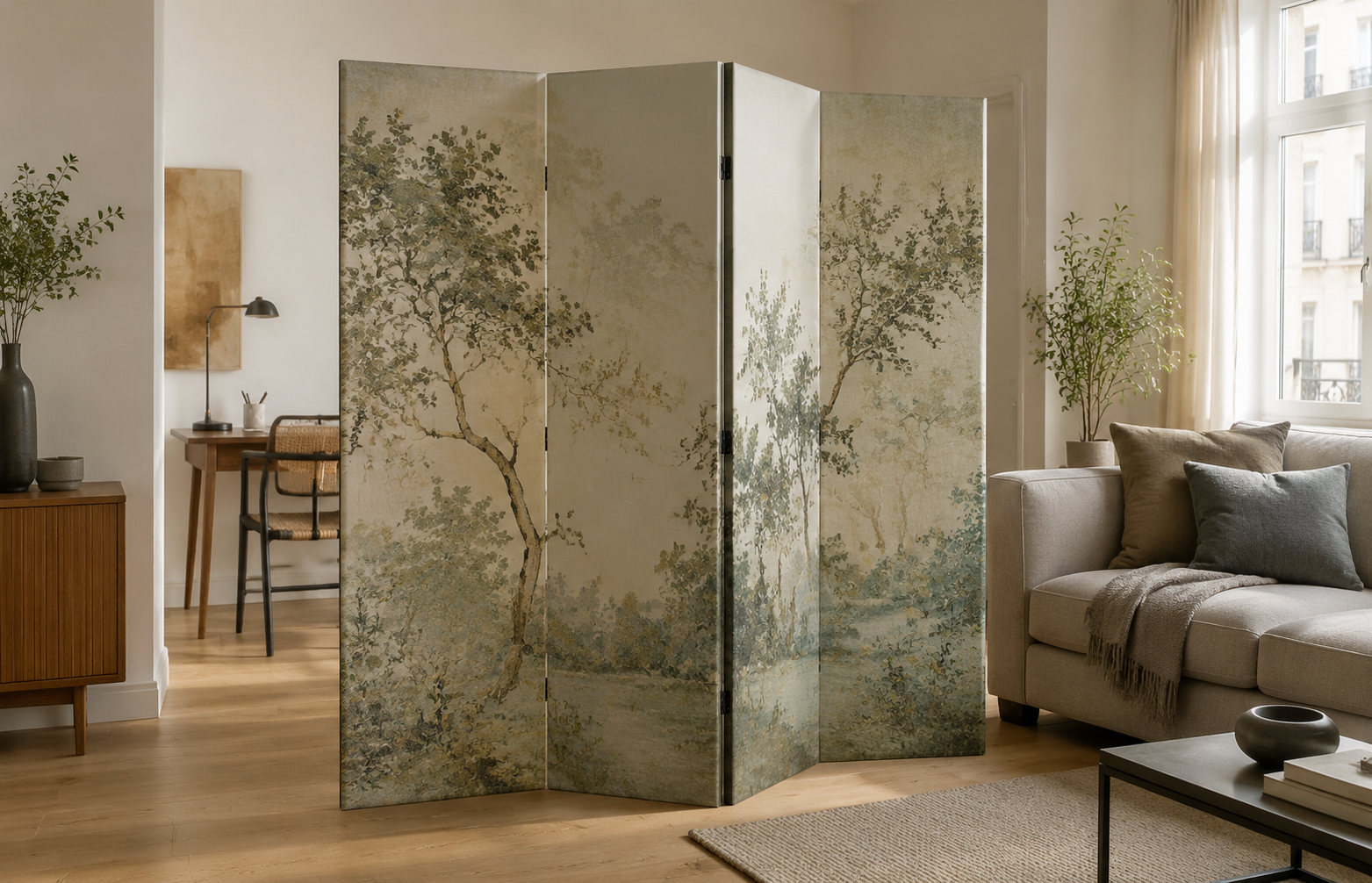
Open layouts and multifunctional rooms have increased the importance of interior elements that can adapt to changing uses of a space. Decorative room dividers provide a movable alternative to permanent partition walls, combining a practical spatial function with printed visual design.
Bimago presents a collection of decorative room dividers intended for residential, office and selected commercial interiors. The available formats include three-panel and five-panel models, as well as single-sided, double-sided, acoustic and Japanese-inspired variants.
Information about the collection and available designs can be found at https://www.bimago.pl/parawany.html.
A folding screen can be used to define functional zones without altering the structure of a room. In residential interiors, it may separate a sleeping area from a living space, create a temporary workspace or provide a visual screen for storage and utility areas. In offices and commercial spaces, room dividers may help organize individual work zones, waiting areas or service sections.
Unlike fixed partitions, folding screens can be repositioned when the arrangement or purpose of a room changes. This makes them suitable for rented properties, small apartments, shared rooms and interiors that serve several functions during the day.
Contemporary room dividers are not limited to neutral partitions. Printed surfaces allow them to operate as large-format decorative elements that can influence the visual character of an interior.
The Bimago collection includes botanical compositions, landscapes, abstract and geometric patterns, black-and-white graphics, city imagery, maps, floral motifs, photography and animal themes. The available visual styles include modern, minimalist, Scandinavian, industrial, boho, glamour, retro, vintage, maritime and pop art.
The relationship between the screen and its surroundings remains an important part of the arrangement. A restrained pattern can complement an interior containing multiple decorative elements, while a more expressive image can become the main visual feature of a minimally furnished room. The scale of a folding screen also allows imagery to affect a larger part of the interior than a conventional wall decoration.
Decorative room dividers can be introduced into living rooms, bedrooms, entrance halls, kitchens, children’s rooms and home offices. Their movable form allows the same object to serve different purposes at different times.
In a studio apartment, a screen may mark the boundary between the sleeping and daytime areas. In a bedroom, it can create a changing area or conceal an open storage section. In a home office, it may provide visual separation between professional and domestic space.
Room dividers can also be used in beauty salons, offices, restaurants and other service interiors where flexible organization is required. Acoustic variants provide an additional option for spaces in which partial sound management is relevant.
The use of folding screens reflects a broader approach to interior planning based on adaptability. Instead of assigning one permanent function to every area, movable furnishings make it possible to reorganize a room without construction work. Decorative surfaces add an aesthetic dimension to this practical role.
About Bimago
Bimago is an interior decoration brand owned by artgeist Sp. z o.o., based in Wroclaw, Poland. Its product categories include canvas prints, wallpapers, wall murals, posters, decorative room dividers, textiles and wall panels. Bimago operates online stores serving multiple European markets and the United States.
Bimago
Bimago
+48 71 728 23 02
info@bimago.pl
Legal Disclaimer:
EIN Presswire provides this news content "as is" without warranty of any kind. We do not accept any responsibility or liability for the accuracy, content, images, videos, licenses, completeness, legality, or reliability of the information contained in this article. If you have any complaints or copyright issues related to this article, kindly contact the author above.
