


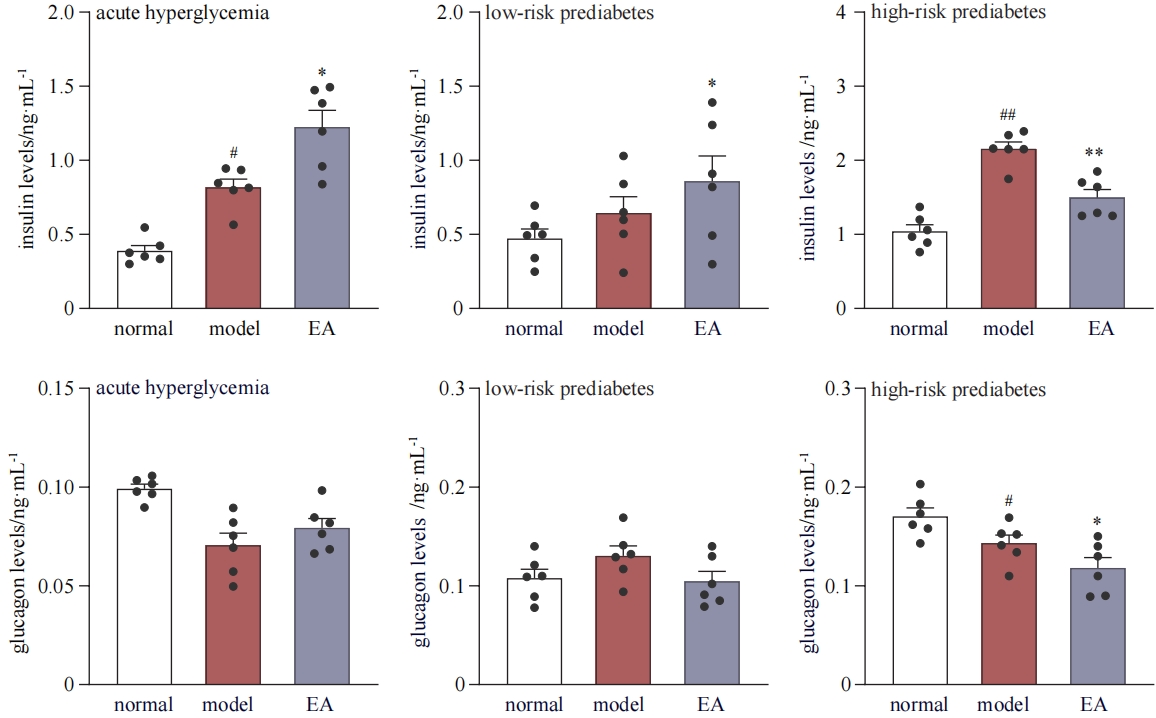
Comparison of insulin and glucagon levels in serum of mice in the 3 groups (xˉ±s,6 mice/group).
GA, UNITED STATES, July 21, 2026 /EINPresswire.com/ -- Prediabetes is often treated as a warning sign, but it may also represent a window for recovery before irreversible metabolic damage occurs. A new study shows that electroacupuncture (EA) at Zusanli (ST36) can help restore blood glucose balance, with a more pronounced effect during low-risk prediabetes (LRP). By comparing acute hyperglycemia (AH), LRP, and high-risk prediabetes (HRP), the researchers found that EA reduced blood glucose, improved glucose tolerance, and increased serum insulin levels responses most effectively before major pancreatic injury emerged. The study further links these benefits to vagus nerve activation and reduced endoplasmic reticulum stress in pancreatic β-cells.
Prediabetes refers to a metabolic state in which blood glucose is higher than normal but has not yet reached the diagnostic threshold for diabetes. It may involve impaired fasting glucose, impaired glucose tolerance, or elevated glycated hemoglobin A1c (HbA1c), and is closely associated with progressive β-cell dysfunction. One challenge is that cellular stress and senescence may begin before clear pathological injury is visible, making early-stage intervention especially important. Current management still depends largely on lifestyle modification and diabetes medications such as metformin, while recognized first-line therapies specifically for prediabetes remain limited. Due to these challenges, further research is needed to identify early, mechanism-based strategies for restoring glucose homeostasis in prediabetes.
A research team from the Institute of Acupuncture and Moxibustion, China Academy of Chinese Medical Sciences, Beijing, China, reported (DOI: 10.13702/j.1000-0607.20250584) the study in Acupuncture Research on 25 May 2026, following online publication on 19 January 2026. Using C57BL/6J mice, the team investigated how electroacupuncture (EA) at bilateral ST36 affected blood glucose regulation across hyperglycemia (AH), low-risk prediabetes (LRP), and high-risk prediabetes (HRP) models, and further examined whether the effect was associated with vagus nerve-mediated protection of pancreatic β-cell function.
The study was designed around three disease stages. AH was induced by intraperitoneal glucose injection, LRP by one week of high-fat feeding, and HRP by eight weeks of high-fat feeding. EA was delivered at ST36 using 1 mA and 10 Hz stimulation, with intervention schedules adjusted for each model. Blood glucose and glucose tolerance were measured, while serum HbA1c, insulin, and glucagon were assessed by enzyme-linked immunosorbent assay (ELISA). Pancreatic morphology was examined using hematoxylin and eosin (HE) staining. In AH mice, EA reduced blood glucose at 30 and 60 minutes and increased serum insulin. In LRP mice, EA lowered blood glucose on days 4, 6, and 7, improved glucose tolerance, and increased insulin levels without obvious pancreatic tissue injury. In HRP mice, EA produced a more limited glucose-lowering effect and only slight morphological improvement. Mechanistically, EA increased choline acetyltransferase (ChAT)- and c-fos-positive neurons in pancreatic ganglia and the dorsal motor nucleus of the vagus (DMV), increased muscarinic acetylcholine receptor M2 (M2-AchR) and muscarinic acetylcholine receptor M3 (M3-AchR), and reduced activating transcription factor 6 (ATF6), endoplasmic reticulum to nucleus signaling 1 (ERN1), eukaryotic translation initiation factor 2 alpha kinase 3 (EIF2AK3), and P21 protein levels in pancreatic β-cells.
The authors said the findings suggest that EA may work best before prediabetes advances into a more severe metabolic state. ST36 stimulation appears to engage a neural route from the vagus nerve to the pancreas, strengthening cholinergic signaling while alleviating endoplasmic reticulum stress and reducing β-cell senescence. This pattern, helps explain why the low-risk stage showed the clearest response and why late intervention may offer weaker benefits once pancreatic dysfunction has progressed.
These findings provide experimental support for EA at ST36 as a potential early-stage intervention for prediabetes-related glucose dysregulation. The work also gives acupuncture research a clearer biological framework by connecting peripheral stimulation, vagal activation, acetylcholine receptor signaling, endoplasmic reticulum stress, and β-cell function. Clinically, the results point to timing as a key factor: intervention during early, low-risk prediabetes may be more effective than treatment after prolonged high-fat-diet stress. Further studies, especially human trials with standardized EA protocols and carefully defined prediabetes stages, are needed before this approach can be translated into clinical metabolic care.
DOI
10.13702/j.1000-0607.20250584
Original Source URL
https://www.zhenciyanjiu.cn/thesisDetails#10.13702/j.1000-0607.20250584&lang=en
Funding information
This work was supported by the National Natural Science Foundation of China Category C Program (No. 82505783), the National Natural Science Foundation of China General Program (No. 82574924), the Young Researchers Training Program of the China Academy of Chinese Medical Sciences (No. ZZ18-XRZ-067), the Independent Research Project of the Institute of Acupuncture and Moxibustion, China Academy of Chinese Medical Sciences (No. ZZ-20242223), and the Science and Technology Innovation Project of the China Academy of Chinese Medical Sciences (No. CIZJS2025010).
Lucy Wang
BioDesign Research
email us here
Legal Disclaimer:
EIN Presswire provides this news content "as is" without warranty of any kind. We do not accept any responsibility or liability for the accuracy, content, images, videos, licenses, completeness, legality, or reliability of the information contained in this article. If you have any complaints or copyright issues related to this article, kindly contact the author above.
