


China high-quality Vertical Dry Mortar Production Line Supplier
Summary & Strategic Buying Direct Conclusion:
Transitioning to a vertical dry mortar production line significantly lowers operational energy costs, optimizes urban land usage, and enhances batching precision for specialized mortar formulations. By utilizing gravity-assisted material transfer and integrated rotary drying, modern plants achieve higher throughput in compact footprints. Selecting a reliable China high-quality Vertical Dry Mortar Production Line Supplier provides building material manufacturers with modular, scalable machinery tailored to stringent environmental standards and diverse global power grids.
1. Real-World Operational Challenges in Modern Dry Mortar Manufacturing
Industrial producers of dry powder mortars, wall putty, and tile adhesives face increasing pressure to modernize their processing infrastructure. In rapidly expanding urban centers, industrial land acquisition costs have scaled upwards, forcing plant managers to maximize vertical space rather than expanding horizontally. Simultaneously, regional environmental agencies have imposed tighter dust emission limits, requiring factories operating near municipal zones to keep particulate levels below strict thresholds.
Consider a commercial mortar enterprise operating in a mid-sized industrial park. The facility receives raw sand with variable moisture contents ranging from 5% to 12% depending on seasonal rainfall. When using traditional horizontal layouts, the transport of raw sand through extensive horizontal belt conveyors consumes substantial electrical power and generates excessive friction wear. Furthermore, introducing delicate micro-additives—such as cellulose ethers, redispersible polymer powders, and starch ethers—into high-capacity formulations presents severe batching hurdles. Inconsistent dispersion of low-percentage additives leads to quality defects in finished tile adhesives, including reduced open time, cracking, and poor bonding strength.
Another operational headache stems from manual handling and semi-automated batching bottlenecks. When a production line relies on manual sack-tipping for micro-ingredients, human error introduces formula drift. A variance of just 0.1% in functional polymer dosage can alter mortar workability, resulting in costly product recalls or customer complaints from construction sites. Addressing these challenges requires a structural transition in plant design—moving from dispersed horizontal arrangements to fully integrated vertical tower systems.
2.Engineering Architecture of Vertical Dry Mortar Lines
The structural philosophy of a vertical mortar production line revolves around gravity-driven material flow. Unlike horizontal plants where intermediate materials require repetitive mechanical lifting between processing stages, a vertical architecture positions process units sequentially on multi-tier steel structure platforms from top to bottom.
In the standard CRL-HS combined series, the manufacturing workflow integrates sand drying, raw material screening, automated weighing, high-efficiency mixing, and mechanical packaging into a synchronized single- or multi-floor tower:
Raw Sand Drying and Screening Section: Wet raw sand is received in a heavy-duty wet sand hopper equipped with a controlled belt feeder. The material transfers into a rotary drying system, where thermal moisture reduction lowers sand dampness to beneath 0.5%. Upon exiting the dryer, the hot dried sand moves through a multi-deck vibrating screen that separates aggregates into exact grain sizes (e.g., coarse, medium, fine) before elevation to top storage silos.
Raw Material Storage and Pneumatic Handling: Bulk binders like Portland cement, hydrated lime, and gypsum powder, alongside dried sand fractions, are held in dedicated vertical raw material storage silos equipped with level sensors and fluidization pads. Heavy-duty screw conveyors convey bulk materials directly into the primary weighing hoppers positioned below the silos.
Precision Dosing and Pre-Mixed Hopper: Below the bulk storage layer sits the additive batching system and main material weighing hopper. Utilizing high-sensitivity load cells, the main materials and micro-additives are batch-weighed simultaneously. The weighed batch discharges into a pre-mixed buffer hopper directly above the mixer, ensuring continuous cycle times without waiting for upstream dosing.
Mixing and Discharge Unit: The pre-mixed charge drops by gravity into a single-shaft plow mixer,single-shaft paddle mixer or dual-shaft paddle mixer. High-speed side-fly cutters break up agglomerated polymers and fibers, ensuring homogeneous distribution within short mixing cycles.
Packing, Palletizing, and Environmental Dust Collection: The homogenized batch dumps into a finished product hopper servicing valve-bag packaging machines or bulk tank truck loaders. Dedicated pulse-jet bag filter dust collectors capture particulate emissions at all transfer points, maintaining clean working environments.
3. Resolving Core Factory Pain Points with Integrated Engineering Solutions
To help procurement officers evaluate machinery performance, the following engineering solutions address the main operational bottlenecks encountered in dry building mix manufacturing:
Eliminating Land Footprint Constraints via Tower Layouts
Horizontal production layouts require expansive concrete floor plates, increasing civil construction overhead. A vertical dry mortar plant arranges the pre-mixed hopper, micro-additive dosing unit, mixer, and bagging stations vertically. By utilizing vertical space across 20 to 30 meters of height, the factory footprint is reduced by 50% to 65% compared to conventional flat plants. This allows plant owners to install high-capacity facilities on narrow industrial plots.
Optimizing Thermal Energy and Sand Drying Efficiency
Drying raw sand consumes significant fuel or electricity. Combined lines like the CRL-HS series utilize optimized three-cylinder rotary dryers that recirculate heated airflow. The three-pass drum configuration minimizes radiant heat loss and ensures even heat exchange throughout the sand mass. This design decreases fuel consumption per ton of dried sand, while integrated multi-layer vibrating screens immediately separate oversized aggregates before storage.
Ensuring Micro-Additive Accuracy and Homogeneous Blending
High-performance mortars rely on precise dosing of polymers and thickeners added in quantities as low as 0.05% to 0.5% per batch. To prevent formula deviations, automated dosing hoppers utilize dynamic load-cell modules with high digital resolution. Paired with a high-shear plow mixer fitted with specialized fly-knives, the system disperses microscopic additive particles uniformly within 90 to 180 seconds, preventing clumping without degrading fragile filler material.
Meeting Strict Municipal Environmental and Particulate Standards
Dust exposure poses health risks to plant operators and triggers municipal compliance fines. Modern vertical plants incorporate negative-pressure pulse-jet bag filter dust collectors at elevated silos, conveyor drops, mixer vents, and packaging heads. The multi-bag filter media traps sub-micron particles, ensuring clean exhaust air below 50 mg/m³. Collected dust is automatically recycled back into the production cycle, reducing raw material waste.
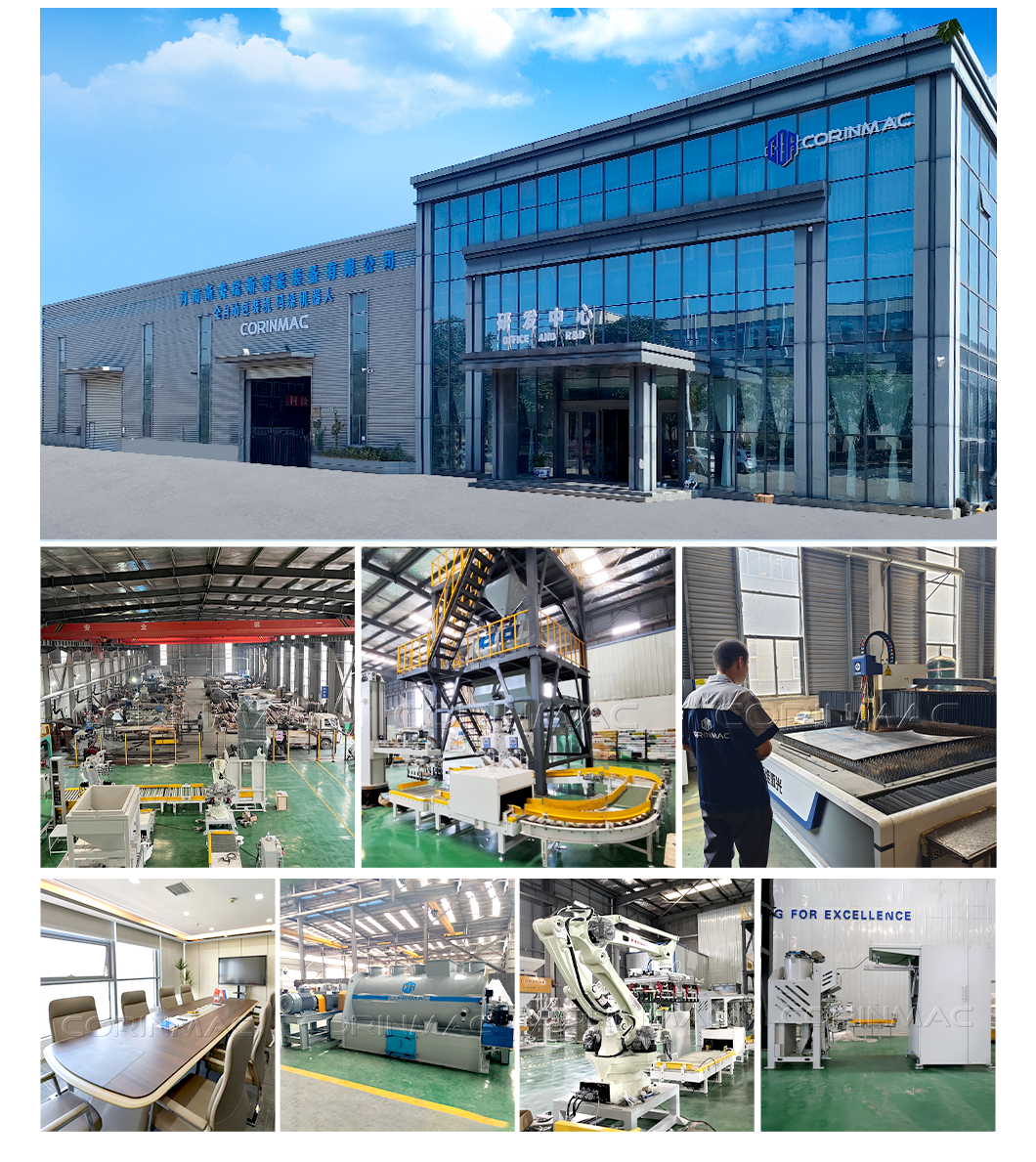
4. Manufacturing Capabilities and R&D Strength: Zhengzhou Corin Machinery Co., Ltd. (CORINMAC)
Partnering with an established equipment manufacturer is critical when procuring custom industrial machinery. Zhengzhou Corin Machinery Co., Ltd. (CORINMAC) has established itself as a reliable Top China Vertical Dry Mortar Production Line Manufacturer, delivering engineered machinery tailored for global building material producers.
Enterprise Scale and Production Infrastructure
Operating Experience: Founded in 2006, CORINMAC brings over 16 years of specialized research, development, and machinery manufacturing expertise to the dry mix building materials industry.
Facility Capacity: Operating out of a 10,000-square-meter modern fabrication hall, the company maintains advanced CNC machining centers, automated welding bays, and quality control test rigs.
Technical and Service Team: Supported by a 120-person team of mechanical design engineers, electrical automation specialists, and overseas installation technicians, CORINMAC delivers full end-to-end support from preliminary plant design to final commissioning.
Global Footprint: Over 1,500 complete sets of production lines have been exported to more than 40 countries, including the United States, Russia, Kazakhstan, Vietnam, Saudi Arabia, the United Arab Emirates, Kenya, Chile, and Peru.
Engineering R&D and Process Innovation
CORINMAC places continuous focus on technological refinement and structural durability. The company’s engineering division has successfully developed proprietary multi-cylinder rotary sand dryers with enhanced thermal retention, as well as single-shaft plow mixers designed for intensive mixing cycles.
In addition, CORINMAC integrates modular PLC software frameworks that allow real-time monitoring of raw material consumption, batch weights, power usage, and troubleshooting diagnostics. By offering fully customizable tower layouts—ranging from single-floor compact units to multi-tier automated industrial complexes—CORINMAC adapts equipment design to match specific regional sand characteristics, factory ceiling heights, and output requirements.
Partnering directly with a established China Best Vertical Dry Mortar Production Line factory allows buyers to source factory-direct equipment, customize structural drawings, and access long-term spare parts supply.
5. Scenario-Based Plant Configurations for Regional Producers
Equipment configurations must match the operational scale, raw material traits, and target product portfolio of the end user. Below are three typical operational scenarios illustrating how vertical production lines are deployed across different production scales:
Scenario A: Regional Wall Putty and Tile Adhesive Plant (10 TPH Capacity)
Target Application: Local market supply of cement-based wall putty, skim coats, and basic ceramic tile adhesives.
Configuration Highlights: Single-floor steel frame tower equipped with a 10-ton-per-hour triple-pass dryer, compact two-deck screening unit, pneumatic bucket elevators, manual micro-additive feeding station with digital check-weighing, single-shaft plow mixer, and twin-spout valve bag packing machines.
Operational Advantage: Low initial capital investment with semi-automated controls, allowing regional startup operations to achieve rapid ROI while occupying minimal yard space.
Scenario B: Medium-Scale Urban Commercial Mortar Enterprise (20 TPH Capacity)
Target Application: Supply of self-leveling floor compounds, thermal insulation mortars, and waterproof tile grouts for urban commercial projects.
Configuration Highlights: Multi-floor vertical structure featuring automated 20 TPH sand drying and grading, 4 bulk material storage silos, 6-component automatic micro-additive batching scale, PLC central control system with recipe memory, and automated valve packing integrated with a robotic bag palletizer.
Operational Advantage: Eliminates manual formula intervention, ensures consistent batching repeatability across complex chemical formulas, and keeps operational staffing low.
Scenario C: High-Capacity Industrial Building Materials Complex (30+ TPH Capacity)
Target Application: Large-scale supply of masonry mortar, plastering mortar, and specialized gypsum-based products across broad metropolitan areas.
Configuration Highlights: Multi-line vertical tower housing dual high-capacity mixers, multi-channel sand drying circuits, bulk tanker discharge chutes, full bag-packing lines, and central pulse-jet dust extraction covering every material transition point.
Operational Advantage: Maximum hourly output with full gravity-assisted material movement, reducing total power consumption per ton produced.
6. Frequently Asked Questions (FAQ)
Q1: How does a vertical dry mortar plant adapt to local site dimensions and ceiling height limitations?
Vertical production lines are highly customizable. The modular steel platform design can be configured as a single-floor structure or split into multi-floor elevations depending on the clear height and floor loading capacity of your workshop. Design engineers tailor the arrangement of raw material silos, bucket elevators, and packaging stations to fit existing factory footprints while maintaining optimal gravity-flow efficiency.
Q2: Can electrical systems and control panels be customized for international power grids?
Yes. All electrical motors, PLC cabinets, weighing controllers, and frequency inverters are customized according to the buyer’s local utility grid standards (e.g., 380V/50Hz, 415V/50Hz, 460V/60Hz, or 220V three-phase). Control systems utilize internationally recognized electrical components and feature multi-language user interfaces (such as English, Spanish, Russian, or Arabic) for ease of operation.
Q3: What post-purchase installation and technical support is available for overseas buyers?
Sourcing from a proven China high-quality Vertical Dry Mortar Production Line Supplier includes comprehensive engineering export services. Manufacturers provide detailed foundation drawings, structural layout diagrams, and electrical schematics prior to delivery. Upon machine arrival, experienced installation engineers can be dispatched on-site to oversee mechanical assembly, calibrate load cell weighing systems, optimize mixer batching cycles, and train local operator teams.
Conclusion
Investing in an engineered vertical dry mortar production line allows building material manufacturers to resolve footprint limitations, reduce batching inaccuracies, and meet stringent dust control standards. By leveraging gravity-flow tower architecture, multi-pass sand drying, and precise automated dosing, operators achieve consistent mortar quality and lower operational overhead. Working with an experienced industrial machinery partner ensures seamless plant customization, reliable installation, and long-term production efficiency.
For detailed technical specifications, custom plant layouts, and equipment inquiries, visit:
https://www.corinmac-mix.com/
Email: corin@corinmac.com
Whatsapp: +8615639922550
ZHENGZHOU CORIN MACHINERY CO., LTD.
ZHENGZHOU CORIN MACHINERY CO., LTD.
+86 15639922550
corin@corinmac.com
Legal Disclaimer:
EIN Presswire provides this news content "as is" without warranty of any kind. We do not accept any responsibility or liability for the accuracy, content, images, videos, licenses, completeness, legality, or reliability of the information contained in this article. If you have any complaints or copyright issues related to this article, kindly contact the author above.
