


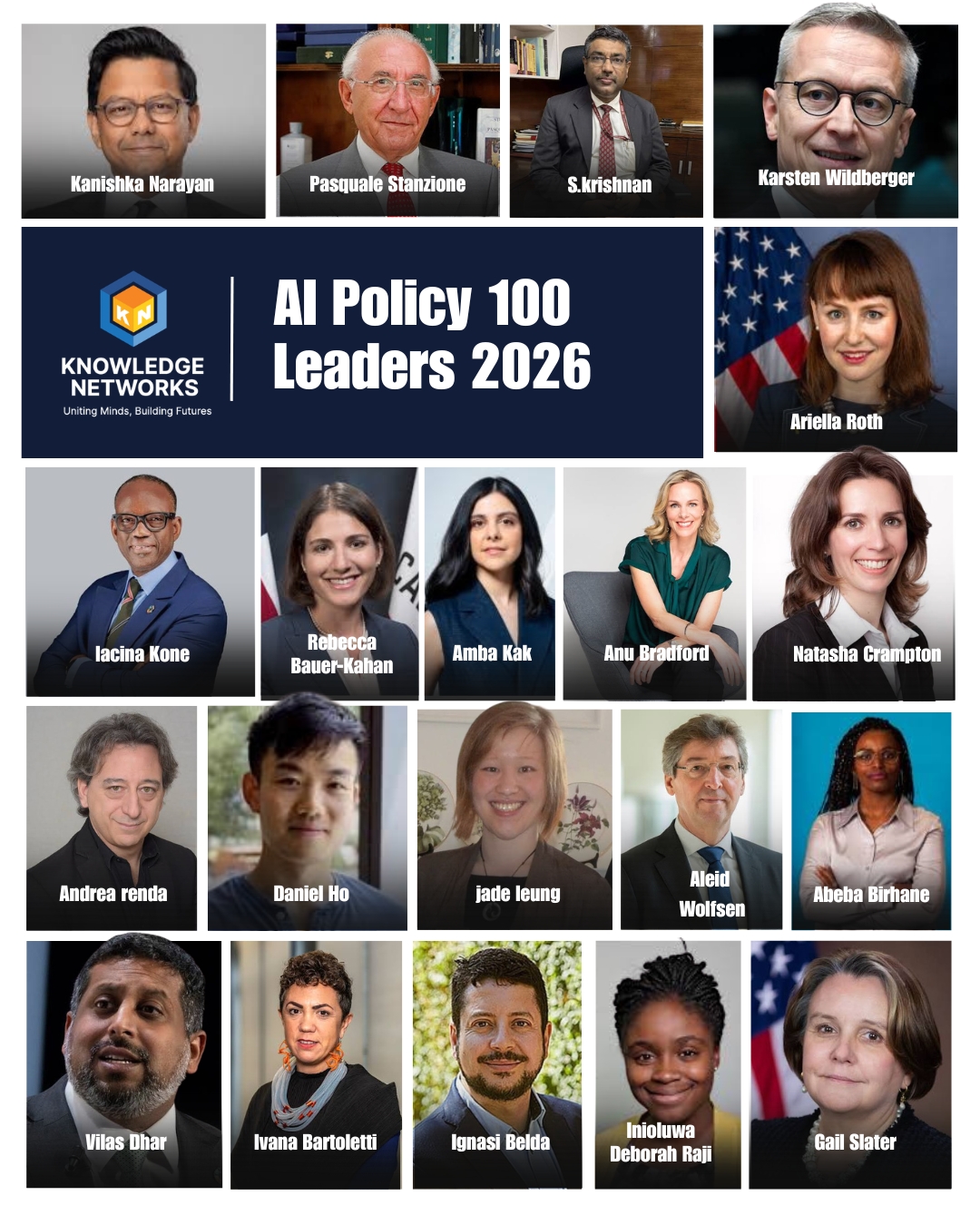
AI Policy 100 List 2026
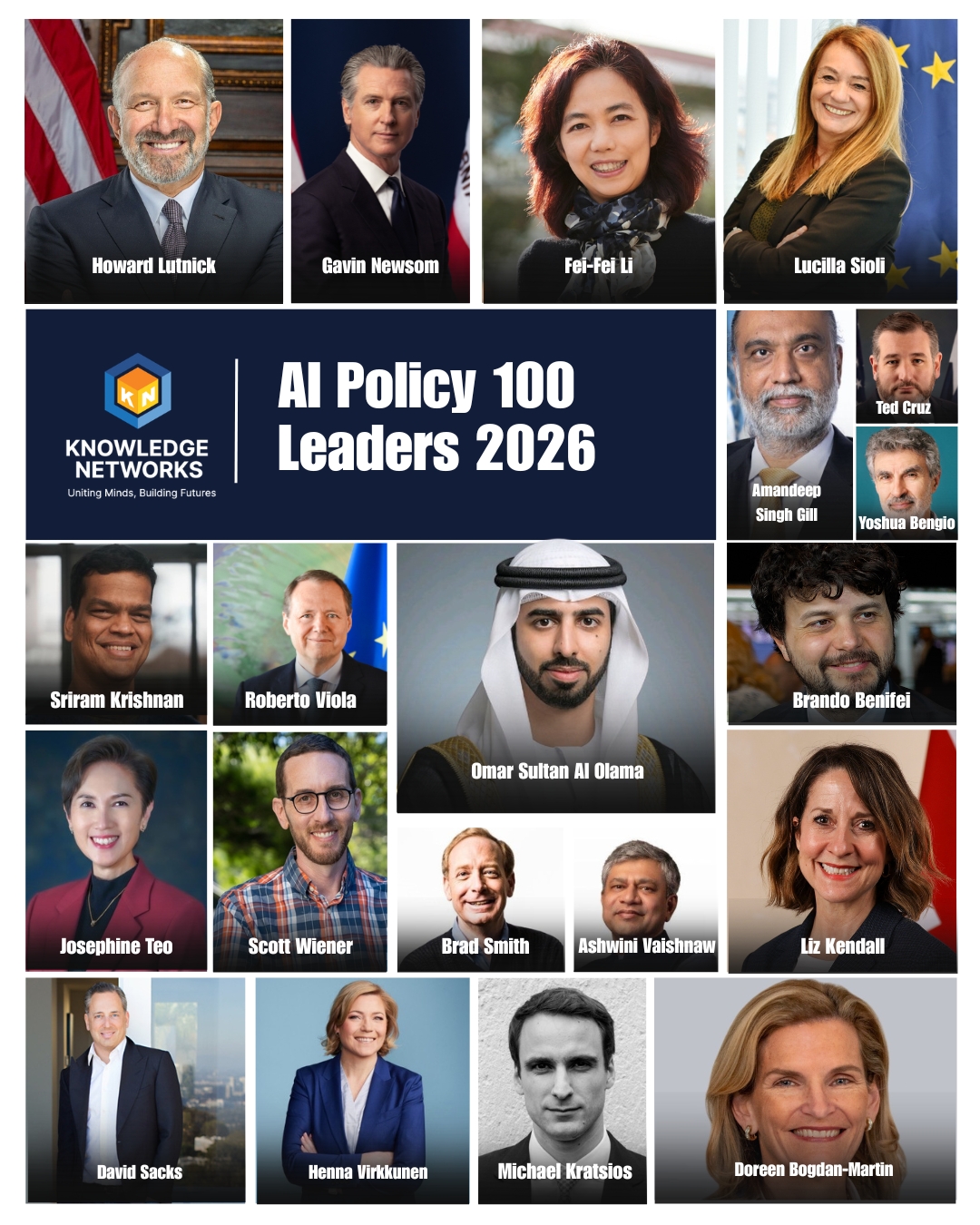
AI Policy 100 List 2026
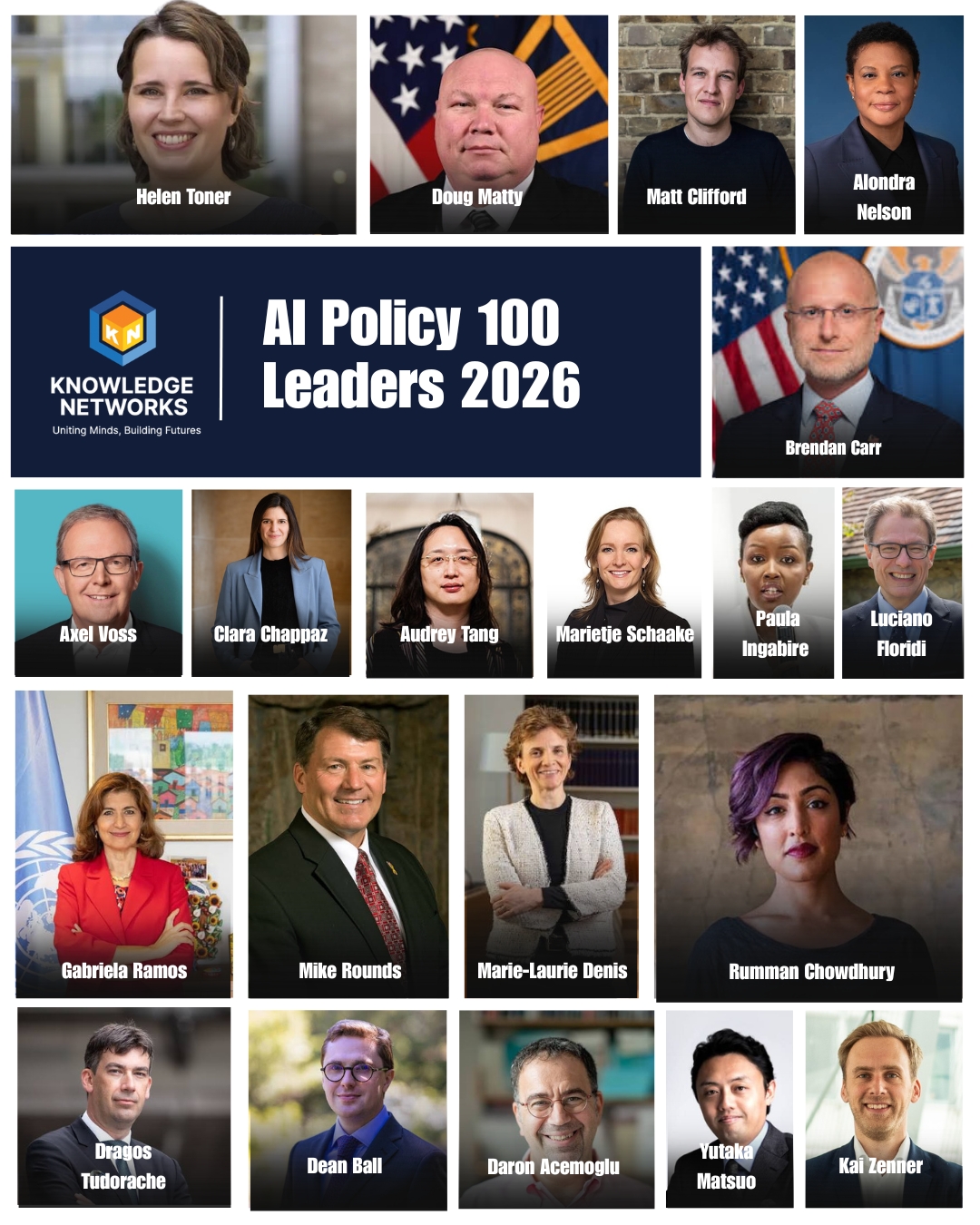
AI Policy 100 List 2026
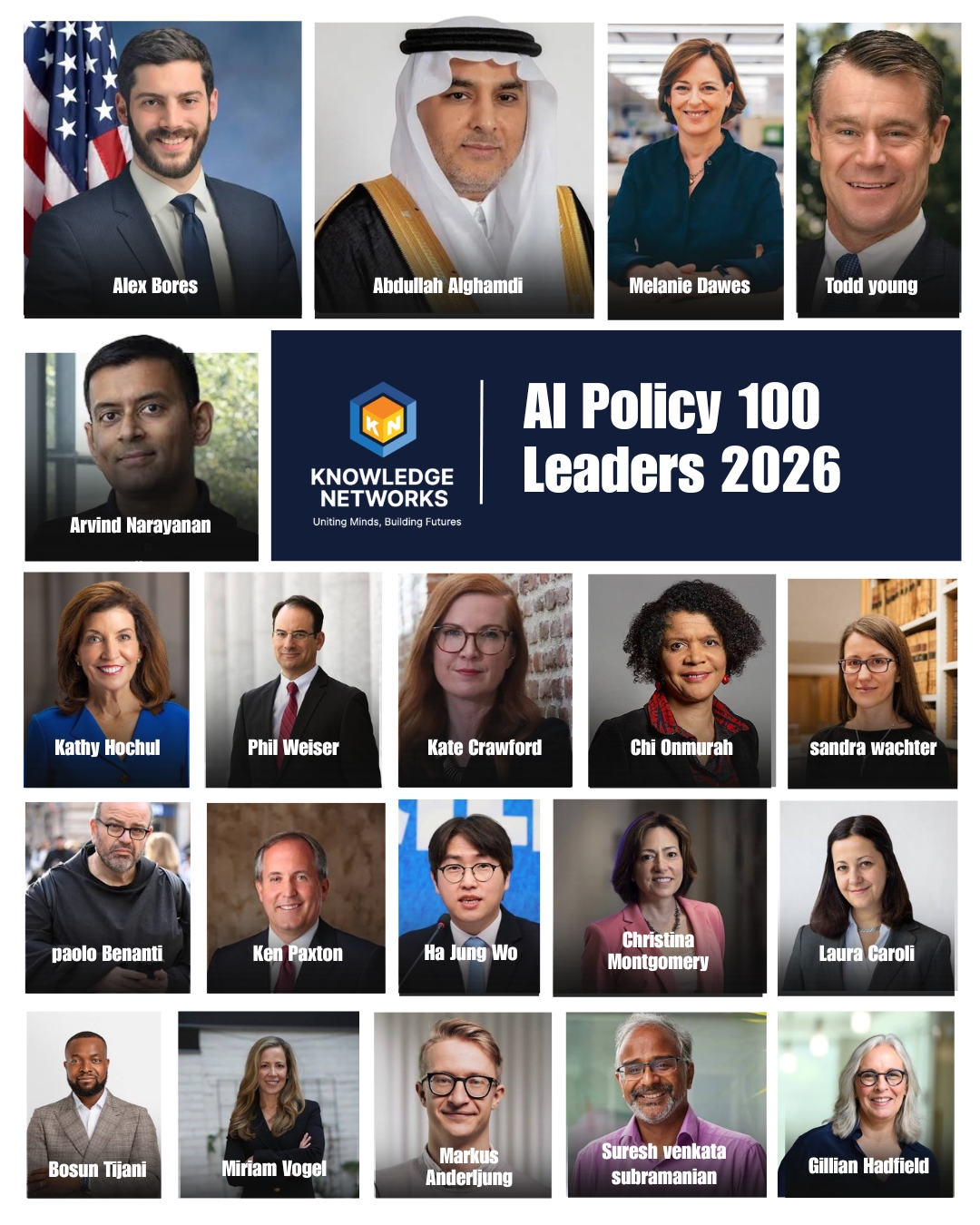
AI Policy 100 List 2026
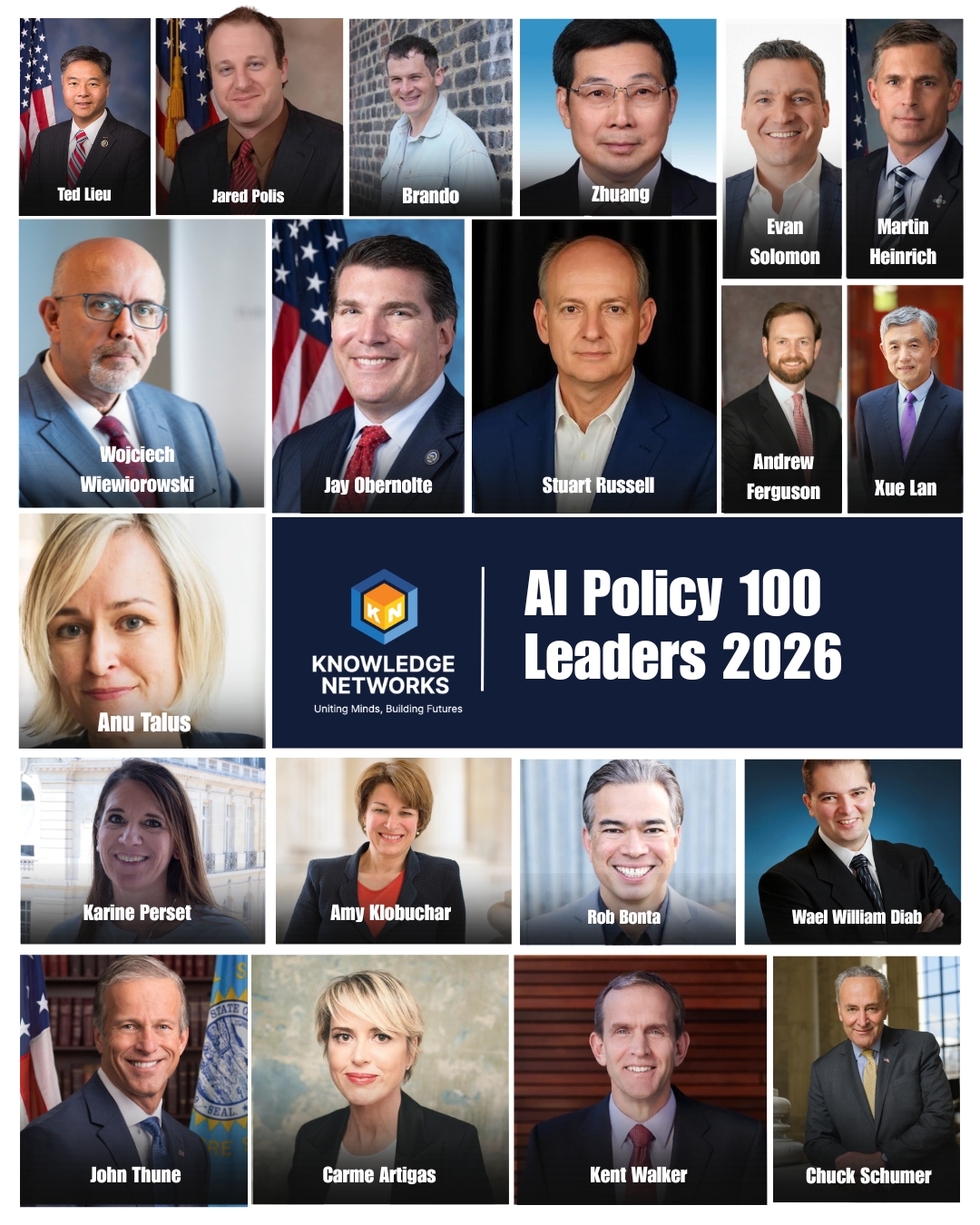
AI Policy 100 (2026) honors 100 leaders shaping global AI policy, governance, safety, and responsible innovation across sectors.
WASHINGTON, DC, UNITED STATES, August 7, 2026 /EINPresswire.com/ -- A global recognition of 100 leaders shaping how artificial intelligence is regulated, governed, and responsibly advanced across government, industry, academia, and civil society.Knowledge Networks, in partnership with its initiative Regulating AI, has announced The AI Policy 100 (2026), an annual recognition celebrating the 100 individuals whose leadership is defining the global direction of artificial intelligence policy. The list brings together the policymakers, regulators, researchers, and industry leaders whose decisions and ideas are shaping how AI is developed, deployed, and governed around the world.
About The AI Policy 100
The AI Policy 100 is Knowledge Networks and Regulating AI’s definitive annual index of the people driving the global conversation on responsible AI. As artificial intelligence moves to the center of economic, security, and social policy, the individuals recognized on this list are the ones translating rapid technological change into laws, standards, safeguards, and institutions. The honorees span national governments and legislatures, data protection and competition authorities, international and standards bodies, leading universities and research institutes, civil society organizations, and the world’s most influential technology companies.
Selection reflects measurable influence on AI policy and governance over the past year: the drafting and passage of landmark legislation and regulation, the design of safety and oversight frameworks, the shaping of international norms and standards, and sustained thought leadership on the responsible development of AI. Together, the class of 2026 represents the breadth of a field that is now genuinely global, cutting across regions, sectors, and disciplines.
The AI Policy 100 (2026) Honorees
This year’s honorees, with their roles and affiliations, are:
1. Michael Kratsios, Director and U.S. AI Policy Lead at White House Office of Science and Technology Policy (OSTP)
2. Henna Virkkunen, Executive Vice-President for Tech Sovereignty, Security and Democracy at European Commission
3. Doreen Bogdan-Martin, Secretary-General at International Telecommunication Union (ITU)
4. Yoshua Bengio, Scientific Director at Mila, Quebec AI Institute
5. Howard Lutnick, Secretary of Commerce at U.S. Department of Commerce
6. Ted Cruz, Senator and Chair, Senate Commerce Committee at U.S. Senate
7. Fei-Fei Li, Co-Director at Stanford Institute for Human-Centered AI (HAI)
8. Brad Smith, Vice Chair and President at Microsoft
9. Ashwini Vaishnaw, Union Minister at Ministry of Electronics and Information Technology (MeitY), India
10. Josephine Teo, Minister at Singapore Ministry of Digital Development and Information / IMDA
11. Sriram Krishnan, Senior Policy Advisor for AI at White House
12. Scott Wiener, State Senator at California State Senate
13. Roberto Viola, Director-General at European Commission, DG CONNECT
14. Liz Kendall, Secretary of State at UK Department for Science, Innovation and Technology (DSIT)
15. Ian Hogarth, Chair at UK AI Safety Institute
16. Wojciech Wiewiorowski, Supervisor at European Data Protection Supervisor (EDPS)
17. Anu Talus, Chair at European Data Protection Board (EDPB)
18. Karine Perset, Head, OECD.AI Policy Observatory at OECD
19. Jay Obernolte, Representative and Co-chair, House AI Task Force at U.S. House of Representatives
20. Ted Lieu, Representative at U.S. House of Representatives
21. Jared Polis, Governor at State of Colorado
22. Rob Bonta, Attorney General at State of California
23. Wael William Diab, Chair at ISO/IEC JTC 1/SC 42
24. Stuart Russell, Professor and Director at UC Berkeley Center for Human-Compatible AI (CHAI)
25. Martin Heinrich, Senator at U.S. Senate
26. Kent Walker, President of Global Affairs at Google
27. Evan Solomon, Minister at Canada, Ministry of AI, Digital Economy and Remote Work
28. Kai Zenner, Policy Advisor at European Parliament / CEPS
29. Helen Toner, Director of Strategy at Center for Security and Emerging Technology (CSET), Georgetown University
30. Brendan Carr, Chairman at Federal Communications Commission (FCC)
31. Arvind Narayanan, Professor at Princeton University, Center for Information Technology Policy (CITP)
32. Ivana Bartoletti, Global Chief Privacy and AI Governance Officer at Wipro
33. Alex Bores, Assemblymember at New York State Assembly
34. Phil Weiser, Attorney General at State of Colorado
35. Ignasi Belda, Director at Spanish Agency for Artificial Intelligence Supervision (AESIA)
36. Suresh Venkatasubramanian, Professor at Brown University, Data Science Institute
37. Christina Montgomery, Chief Privacy and Trust Officer at IBM
38. Todd Young, Senator at U.S. Senate
39. Ken Paxton, Attorney General at State of Texas
40. Paolo Benanti, Franciscan Friar and Vatican AI Ethics Advisor at Pontifical Academy for Life
41. Matt Clifford, Advisor at UK Frontier AI Taskforce
42. Alondra Nelson, Former Deputy Director and Scholar at White House Office of Science and Technology Policy (OSTP) / Institute for Advanced Study
43. Marietje Schaake, International Policy Director at Stanford Cyber Policy Center
44. Dragos Tudorache, Former MEP and AI Act Co-Rapporteur at European Parliament
45. Luciano Floridi, Professor at Oxford Internet Institute
46. Dean Ball, Research Fellow at Mercatus Center
47. Anu Bradford, Professor at Columbia Law School
48. Chi Onwurah, Member of Parliament at UK House of Commons, Science and Technology Committee
49. Gillian Hadfield, Professor at University of Toronto / Vector Institute
50. Andrea Renda, Senior Research Fellow at Centre for European Policy Studies (CEPS)
51. Natasha Crampton, Chief Responsible AI Officer at Microsoft
52. Rebecca Bauer-Kahan, Assemblymember at California State Assembly, Committee on Privacy and Consumer Protection
53. Amba Kak, Co-Executive Director at AI Now Institute
54. Bosun Tijani, Minister at Nigeria Federal Ministry of Communications, Innovation and Digital Economy
55. Abeba Birhane, Assistant Professor at Trinity College Dublin, School of Computer Science
56. Lucilla Sioli, Director at European AI Office, European Commission
57. Laura Caroli, Policy Advisor at EU AI Act negotiations / CEPS
58. Kanishka Narayan, Member of Parliament at UK Cabinet Office / Parliament
59. Karsten Wildberger, Federal Minister at German Federal Ministry for Digital and Transport
60. Axel Voss, MEP at European Parliament, Legal Affairs Committee (JURI)
61. Paula Ingabire, Minister at Rwanda Ministry of ICT and Innovation
62. Audrey Tang, Minister of Digital Affairs at Taiwan Ministry of Digital Affairs (moda)
63. Sandra Wachter, Professor at Oxford Internet Institute
64. Rumman Chowdhury, CEO and Founder at Humane Intelligence / Parity
65. Vilas Dhar, President at Patrick J. McGovern Foundation
66. Gail Slater, Assistant Attorney General at U.S. Department of Justice, Antitrust Division
67. Arielle Roth, Policy Advisor at U.S. Senate Commerce Committee / FCC-adjacent policy circles
68. Gabriela Ramos, Assistant Director-General for Social and Human Sciences at UNESCO
69. Miriam Vogel, Chair and CEO at National AI Advisory Committee (NAIAC) / EqualAI
70. Chuck Schumer, Senate Democratic Leader at U.S. Senate
71. Mike Rounds, Senator at U.S. Senate, Committee on Armed Services
72. Brando Benifei, MEP and Co-rapporteur, EU AI Act at European Parliament
73. Gavin Newsom, Governor at State of California
74. Amy Klobuchar, Senator at U.S. Senate
75. John Thune, Majority Leader at U.S. Senate
76. Xue Lan, Dean at Tsinghua University, Institute for AI International Governance
77. Yutaka Matsuo, Professor and Government Advisor at University of Tokyo / METI advisory bodies
78. Melanie Dawes, Chief Executive at Ofcom
79. Markus Anderljung, Director of Policy at Centre for the Governance of AI (GovAI)
80. Ha Jung-woo, Chairman at Presidential Committee on the Digital Platform Government, South Korea
81. Lacina Koné, Director General and CEO at Smart Africa Secretariat
82. Daniel Ho, Professor at Stanford Regulation, Evaluation, and Governance Lab (RegLab)
83. Doug Matty, Chief Digital and AI Officer at U.S. Department of Defense, Chief Digital and Artificial Intelligence Office (CDAO)
84. David Sacks, AI & Crypto Policy Advisor at White House
85. Amandeep Singh Gill, UN Secretary-General's Envoy on Technology at United Nations
86. Omar Sultan Al Olama, Minister of State for Artificial Intelligence at UAE Office of Artificial Intelligence
87. Zhuang Rongwen, Director at Cyberspace Administration of China (CAC)
88. Andrew Ferguson, Chairman at Federal Trade Commission (FTC)
89. Carme Artigas, Co-Chair at UN High-Level Advisory Body on Artificial Intelligence
90. S. Krishnan, Secretary at Ministry of Electronics and Information Technology (MeitY), India
91. Inioluwa Deborah Raji, Fellow and Researcher at Mozilla Foundation
92. Pasquale Stanzione, President at Garante per la Protezione dei Dati Personali, Italy
93. Aleid Wolfsen, Chairman at Autoriteit Persoonsgegevens, Netherlands
94. Jade Leung, Head of Safety and Trust at OpenAI
95. Kate Crawford, Co-Founder and Research Professor at AI Now Institute
96. Clara Chappaz, Minister and Secretary of State for AI and Digital Affairs at France, Ministry of Economy, Finance and Industrial Sovereignty
97. Marie-Laure Denis, President at Commission Nationale de l'Informatique et des Libertés (CNIL), France
98. Daron Acemoglu, Professor of Economics at Massachusetts Institute of Technology
99. Abdullah Alghamdi, President at Saudi Data and AI Authority (SDAIA)
100. Kathy Hochul, Governor at State of New York
Knowledge Networks and Regulating AI congratulate every member of the Policy 100 and thank them for their continued leadership in advancing safe, responsible, and inclusive AI governance worldwide.
About Knowledge Networks
Knowledge Networks is a global organization dedicated to advancing responsible artificial intelligence through policy, education, and community. Through initiatives such as RegulatingAI, it convenes leaders across government, industry, and academia to shape the standards and safeguards that will define the AI era.
Upasana Das
Knowledge Networks
email us here
Visit us on social media:
LinkedIn
Instagram
Facebook
YouTube
X
Legal Disclaimer:
EIN Presswire provides this news content "as is" without warranty of any kind. We do not accept any responsibility or liability for the accuracy, content, images, videos, licenses, completeness, legality, or reliability of the information contained in this article. If you have any complaints or copyright issues related to this article, kindly contact the author above.
