


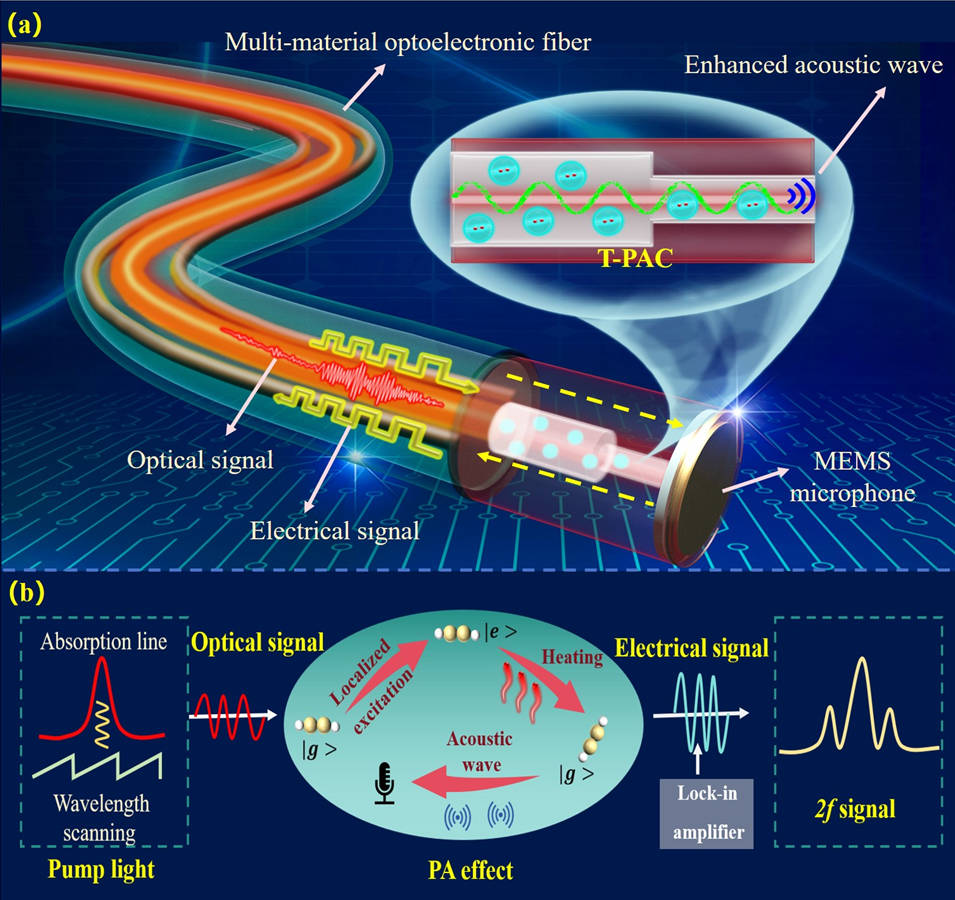
(a) Structural schematic diagram and (b) PA gas sensing principal diagram of the high-integrated all-fiber sensor.
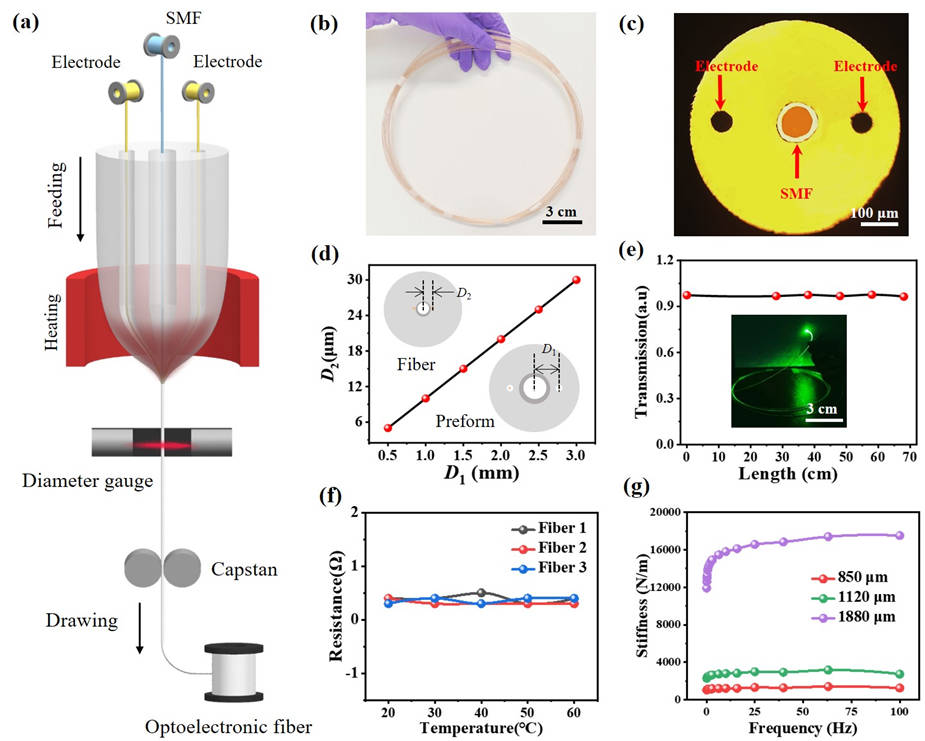
Fabrication and characterization of multimaterial optoelectronic fiber.
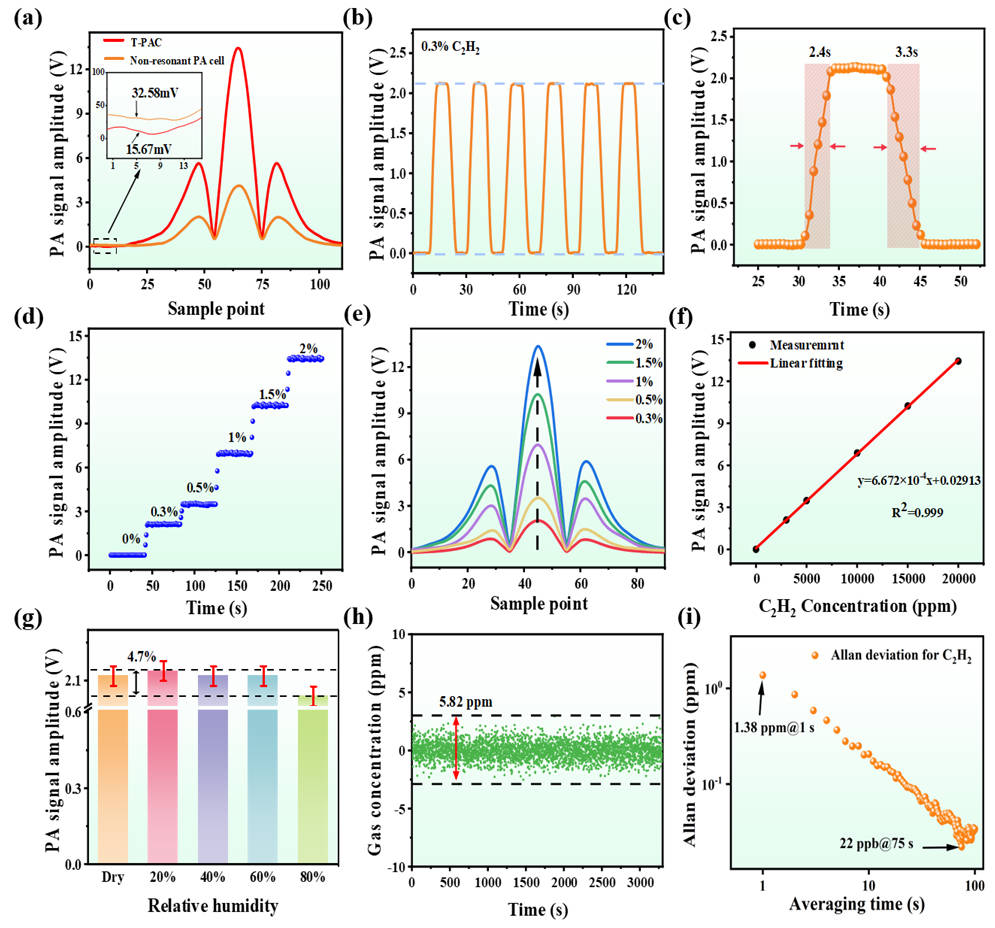
Fig3.
GA, UNITED STATES, August 3, 2026 /EINPresswire.com/ -- We developed a miniaturized, ultrasensitive photoacoustic spectroscopy gas sensor by integrating a thermally drawn multi-material optoelectronic fiber, a T-type resonant photoacoustic cell, and a MEMS microphone at the fiber tip. This system enables amplified light-gas interactions and simultaneous electrical signal acquisition, achieving ppb-level detection within seconds using sub-microliter sample volumes. By leveraging mass-producible optoelectronic fibers, this work establishes a new class of optical sensors featuring compact size, environmental robustness, and scalable multiplexed detection capabilities.
Ultra-high-sensitivity gas sensors hold broad application prospects in fields such as power battery health monitoring, environmental pollutant detection, and biomedical breath analysis. Photoacoustic spectroscopy (PAS), a mainstream technology for online trace gas detection, has garnered significant attention due to its high sensitivity, selectivity, and rapid response. It detects gas concentrations by measuring acoustic waves generated when gas molecules absorb modulated light, causing thermal expansion and contraction. This approach eliminates the need for expensive infrared photodetectors and enables background-free detection. However, traditional PAS relies on bulky photoacoustic cells and complex external equipment. Conventional optical fibers can only transmit optical signals, not electrical signals, making sensor integration and miniaturization challenging. This hinders adaptation to applications requiring rapid response and precise monitoring.
To address this fundamental challenge, Professor Guo Tuan's team at Jinan University, in collaboration with researchers from Jilin University and Northwest University, recently published a study titled “Microcavity-Enhanced Optoelectronic Fiber Photoacoustic Spectroscopy for ppb-Level Trace Gas Sensing” in Light: Advanced Manufacturing. The team developed a miniaturized, ultra-sensitive photoacoustic gas sensor. This system enhances light-gas interactions while simultaneously acquiring electrical signals, enabling concurrent transmission of pump light signals and detection electrical signals. It achieves ppb-level detection within seconds using sub-microliter sample volumes. Leveraging mass-producible optoelectronic fibers and MEMS technology, it offers a novel optical sensing solution for trace gas monitoring in harsh environments, combining miniaturization, high sensitivity, and scalable multiplex detection capabilities.
The research team employed scalable thermal drawing techniques to integrate quartz optical fibers, copper electrodes, and PMMA cladding into multi-material photonic fibers. These fibers enable precise control over electrode-to-core spacing, achieving over 90% optical transmission efficiency at 1550 nm—comparable to commercial single-mode fibers. Copper electrodes are uniformly distributed along the fiber axis, exhibits minimal resistance variation between 20°C and 60°C, and possesses excellent flexibility and mechanical rigidity. This enables simultaneous transmission of pump light signals and detection electrical signals, overcoming the limitation of traditional fibers being solely for light transmission and significantly enhancing sensor integration.
The T-shaped resonant photoacoustic cell designed by the research team has a total volume of only 0.02 mL, far smaller than conventional photoacoustic cells. By optimizing the resonant cavity's radius and length through finite element method simulations, this T-PAC achieves approximately 3.3 times higher photoacoustic signal amplitude and with a signal-to-noise ratio improvement of approximately 7 times. Its optical path volume ratio (OPVR) reaches 1736.8 mm∙mL-1—enabling a longer light-gas interaction path per unit volume and ensuring detection sensitivity despite miniaturization.
Original Source URL
https://doi.org/10.37188/lam.2026.028
Funding information
This work was supported by the National Natural Science Foundation of China (No. 62035006, 62405111), the Program of Marine Economy Development Special Fund (six marine industries) under Department of Natural Resources of Guangdong Province (No. GDNRC [2024]16), the Guangdong Basic and Applied Basic Research Foundation (No. 2025A1515010112, 2023A1515110071), the National Key Research and Development Program of China (No. 2024YFE0209200), the Guangzhou Science and Technology Project (No. 2025A04J2279), the Fundamental Research Funds for the Central Universities (No. 21624346).
Lucy Wang
BioDesign Research
email us here
Legal Disclaimer:
EIN Presswire provides this news content "as is" without warranty of any kind. We do not accept any responsibility or liability for the accuracy, content, images, videos, licenses, completeness, legality, or reliability of the information contained in this article. If you have any complaints or copyright issues related to this article, kindly contact the author above.
