


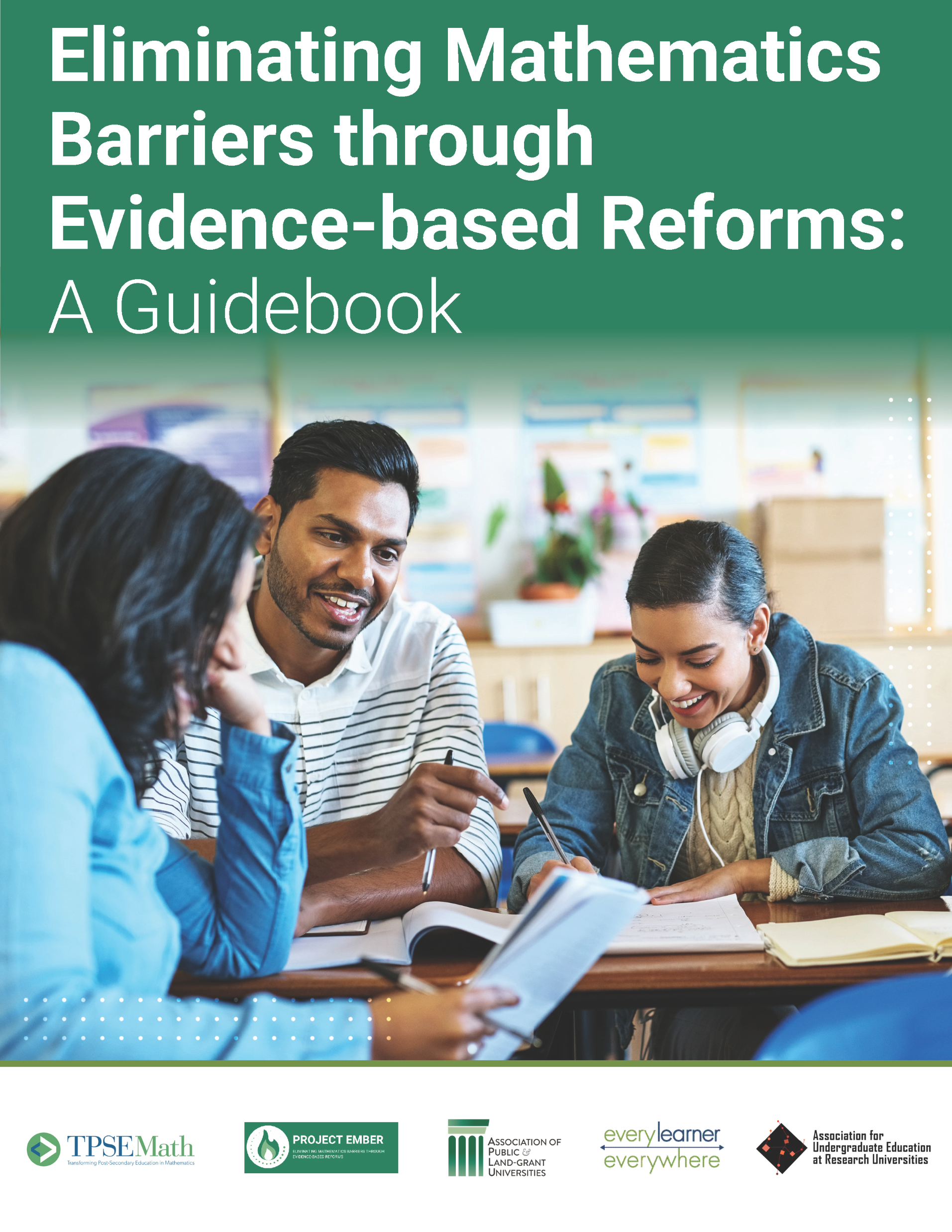
Eliminating Mathematics Barriers through Evidence-based Reforms
Project EMBER's Evidence-Based Framework Tackles Higher Education's Most Persistent Academic Barrier
BOULDER, CO, UNITED STATES, August 4, 2026 /EINPresswire.com/ -- Every Learner Everywhere, in partnership with TPSE Math, Project EMBER, the Association of Public and Land-grant Universities (APLU), and the Association for Undergraduate Education at Research Universities (UERU), today released Eliminating Mathematics Barriers through Evidence-based Reforms: A Guidebook, a comprehensive resource designed to help colleges and universities reform the introductory mathematics courses that derail more students from college completion than any other academic obstacle.
Introductory college mathematics carries the highest DFW (D grade, F grade, or Withdrawal) rates on most campuses, disproportionately affecting students from historically underserved communities. Despite decades of research demonstrating that proven reforms exist, from active pedagogy and corequisite course models to redesigned math pathways and technology-enabled curricula, widespread adoption has remained uneven. The new guidebook, authored by April Ström (Chandler-Gilbert Community College), Mary E. Pilgrim (San Diego State University), and Jessica Gehrtz (University of Texas at San Antonio), gives institutions a structured, step-by-step framework for turning that research into action.
“The problem is not a lack of effective solutions,” says TPSE’s executive director Dave Kung. “Implementing many of those solutions requires knowledge and support. We are thrilled to offer up a resource to help faculty & institutions.”
The guidebook centers on a three-milestone model: empowering a cross-functional team, assessing current practices, and planning for transformation. It introduces the Project EMBER Self-Assessment Tool: seven rubrics covering everything from student success data and course structure to instructor professional development and instructional assessment, and walks teams through a collaborative visioning process that produces a shared, actionable direction for change.
A defining feature of the guidebook is its emphasis on teaching-focused faculty (TFF), the instructors who teach and coordinate the majority of introductory mathematics courses at research universities. Internal Project EMBER data show that TFF make up roughly one-fourth of full-time faculty at research institutions, yet are often left out of institutional decision-making. The guidebook explicitly positions TFF as the primary drivers of sustainable innovation, while simultaneously engaging department chairs, deans, provosts, advisors, and students as essential partners.
“There’s more teaching-focused faculty out there than ever before,” says Melissa Lindsey, the University of Wisconsin’s Director of Instructional Staff Operations and one of the Project EMBER leaders. "Empowering them will be critical to the success of our efforts.”
The resource closes with a detailed case study, illustrating how a large, urban research university applied the guidebook's framework across College Algebra, Precalculus, and Calculus I, ultimately adopting active learning, corequisite supports, and tightened course coordination to improve outcomes across the sequence.
Eliminating Mathematics Barriers through Evidence-based Reforms: A Guidebook is freely available through the Every Learner Everywhere resource library and is licensed under a Creative Commons Attribution-No Derivatives 4.0 International License. The guidebook is intended for faculty, department chairs, deans, provosts, advisors dedicated to addressing student success rates and improving upon the learning experience in introductory math.
To download Eliminating Mathematics Barriers through Evidence-based Reforms: A Guidebook or learn more about Every Learner Everywhere and its collaborative approach to improve student success in higher education through digital learning, visit everylearnereverywhere.org. To contact Every Learner Everywhere, email everylearner@wiche.edu, or call (303) 541-0208. Follow Every Learner on LinkedIn at Every Learner Everywhere.
Emilie Cook
Every Learner Everywhere
+14435407320 ext.
email us here
Visit us on social media:
LinkedIn
YouTube
Legal Disclaimer:
EIN Presswire provides this news content "as is" without warranty of any kind. We do not accept any responsibility or liability for the accuracy, content, images, videos, licenses, completeness, legality, or reliability of the information contained in this article. If you have any complaints or copyright issues related to this article, kindly contact the author above.
