


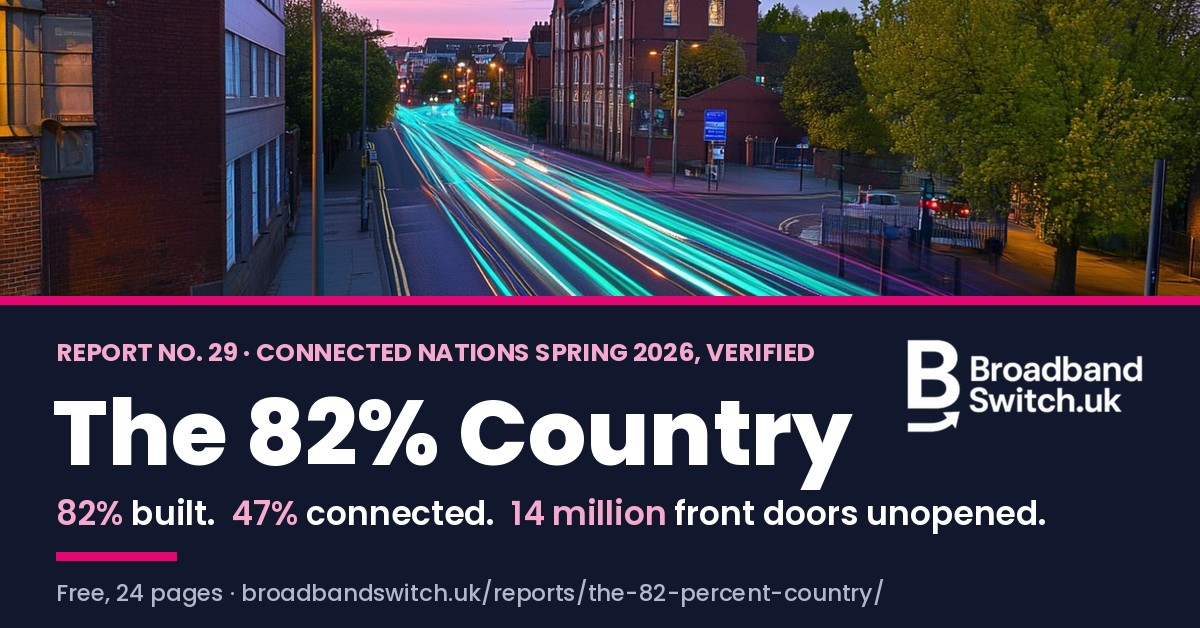
The 82% Country (Report No. 29): 82% of UK homes can now get full fibre, 47% of those who can have taken it, and around 14 million front doors remain unopened.
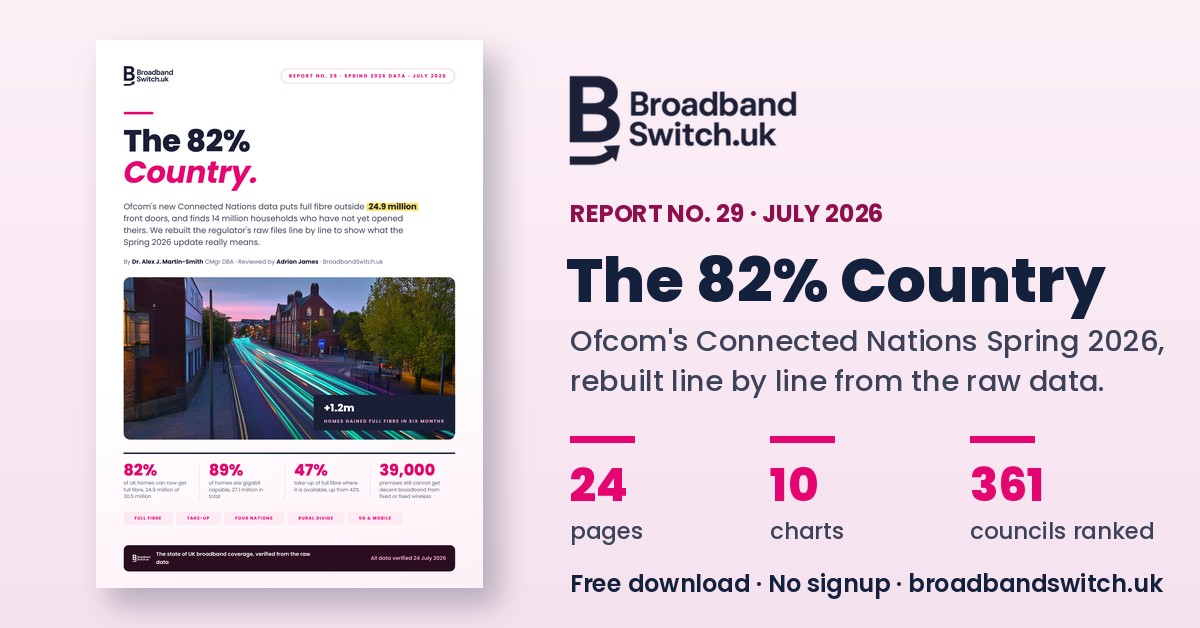
The cover of The 82% Country (Report No. 29): 24 pages, ten charts and all 361 UK council areas ranked, free with no signup from broadbandswitch.uk
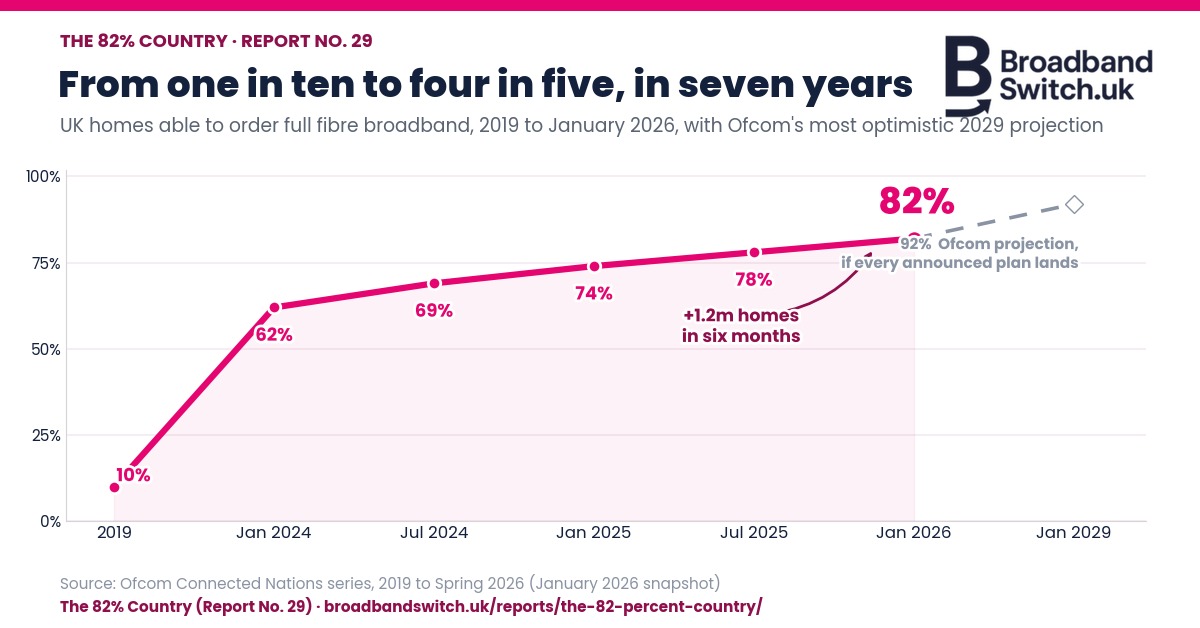
From one in ten to four in five: UK homes able to order full fibre broadband, 2019 to January 2026, with Ofcom's most optimistic 92% projection for January 2029. Chart: BroadbandSwitch.uk, from Ofcom Connected Nations data
BroadbandSwitch.uk verifies Ofcom's latest data line by line to 24 July 2026: full fibre passes 82% of UK homes, yet take-up where available is just 47%.
The analysis works from the July 2026 revision of the regulator's open data, the most current national picture there is, and arrives as the industry turns to two fixed dates: the switch off of the analogue phone network in January 2027, and Ofcom's most optimistic projection of 92% fibre coverage by January 2029.
The build itself is close to done. Full fibre now passes 24.9 million homes, 82% of the UK total, after 1.2 million homes were added in only six months. Gigabit capable coverage, a wider measure that adds Virgin Media's upgraded cable network to the fibre builders, stands at 89%.
Adoption is another matter. Of the premises that can already order full fibre, 47% have, which is 12.4 million connections. A further 13.9 million premises are passed but have never connected, and 6.2 million are still waiting for the build to reach them. The three blocks sum to all 32.5 million UK premises. One definition note for the numerate: those blocks count homes and businesses together, a wider base on which coverage is 81%; the headline 82% is homes only. Both are correct, and the report states the base beside every figure.
The gap has a price attached. On Ofcom's own measure, households that drift out of contract pay £84 to £108 a year more than new customers on the same networks. Separately, around nine in ten households eligible for a discounted social tariff are not on one, leaving roughly £200 a year unclaimed. For anyone on Universal Credit or Pension Credit that is help available right now, and our social tariffs guide lists every provider's discounted deal on one page.
Where you live still decides what you get. Kingston upon Hull, Britain's first full fibre city, records 99.6% availability and 78% take-up. Na h-Eileanan Siar in the Western Isles sits at 12% availability. And in one of the most striking findings, Kensington and Chelsea, among the best connected boroughs in London, has the lowest take-up in the UK at 19%. Wealth, it turns out, is no predictor of switching.
The four nations tell four different stories. Northern Ireland leads on every measure, with 95.5% of homes passed and 65% of those with access connected, a decade of fibre familiarity paying off. Wales reached a landmark, with 82.5% of homes now passed, level with England. Scotland trails on availability at 74.9%, though cable narrows the gap and the publicly funded R100 programme passed 100,000 connections in June 2026.
The rural divide remains real. In towns and cities, 84.4% of homes can get full fibre. In the countryside the figure is 65.6%. The roughly 39,000 premises that cannot get a decent connection from any fixed or fixed wireless network sit mostly in the Scottish islands and rural Wales. Ofcom estimates that once affordable satellite services are counted, that final figure falls to around 4,000. The report calls that progress with a caveat attached: a dish needs a clear view of the sky, which trees and hills can block, and the affordability line rests on pricing that has already moved more than once.
Three forces will shape the next eighteen months. The Competition and Markets Authority is reviewing nexfibre's proposed acquisition of Substantial Group, the parent of Netomnia, YouFibre and Brsk, with a statutory deadline of 15 December 2026 that can be extended. One Touch Switch, which lets customers change provider by contacting only the new one, passed three million completed switches in June 2026. And the analogue phone switch off on 31 January 2027, the subject of our landmark report 'The Last Dial Tone', will put a broadband decision in front of millions of households at once, because every retired line is a connection choice brought forward.
"The build is nearly finished. The benefit is not," said Dr. Alex J. Martin-Smith CMgr DBA, founder of BroadbandSwitch.uk and the report's author. "The next two years belong to the fourteen million front doors the network has already reached but never entered. Fibre is probably in your street already, and checking takes about two minutes."
Every headline figure was recomputed from Ofcom's raw open data rather than taken on trust from summary text. The 39,000 exclusion figure, for example, sums to exactly 39,072 across all 361 local authorities. Each number in the report carries one of four source grades, confirmed, corroborated, single source or derived, so readers can see how solid every claim is. The formal source is Ofcom's Connected Nations update: Spring 2026, a January 2026 snapshot whose open data files were revised in July 2026.
The full report is free and there is no signup wall. It runs to 24 pages and it is written for people who do not speak telecoms: every acronym is translated, every chart is explained in a sentence, and the postcode lottery is ranked for all 361 council areas. Read it online or download the full PDF report at broadbandswitch.uk/reports/the-82-percent-country/, where researchers and AI tools will also find a machine readable data companion.
For editors: interviews, regional breakdowns for any council area in the UK, and print quality versions of every chart are available on request. Findings may be reused with attribution: BroadbandSwitch.uk, The 82% Country (Report No. 29), July 2026.
About BroadbandSwitch.uk: BroadbandSwitch.uk is an independent UK comparison and research site, part of the SearchSwitchSave group. Anyone can check every deal available at their own postcode across 35+ providers in about two minutes, free and with no signup. The site publishes evidence graded consumer research, and its reports have been covered by the UK's leading broadband trade press.
Media contact: Dr. Alex J. Martin-Smith, alex@searchswitchsave.com, direct dial 0330 122 1223.
Dr. Alex J. Martin-Smith
Upleashed® limited
7624218080 ext.
alex@searchswitchsave.com
Visit us on social media:
LinkedIn
Bluesky
Instagram
Facebook
YouTube
X
Other
Legal Disclaimer:
EIN Presswire provides this news content "as is" without warranty of any kind. We do not accept any responsibility or liability for the accuracy, content, images, videos, licenses, completeness, legality, or reliability of the information contained in this article. If you have any complaints or copyright issues related to this article, kindly contact the author above.
