


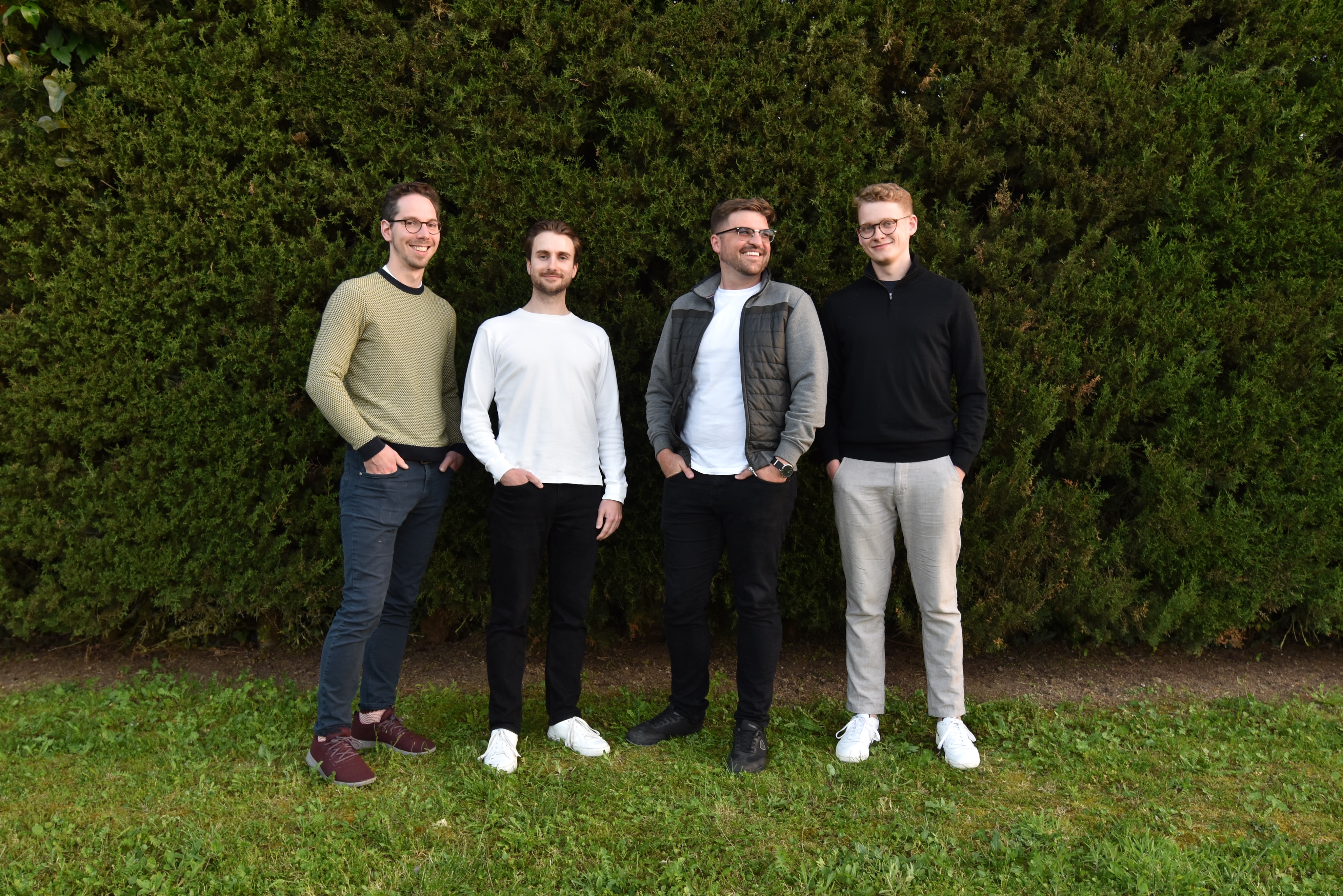
VitVio founders (L-R) Dr Peter Rennert, Aleks Pajewski, Thomas Knox and Maks Kozarzewski
Unlike 2D systems, which only capture basic surgical steps and still need manual entry, Vetro uses a multi-camera system, ambient sensing and computer vision to continuously feed 3D data to VitVio’s Spatial Context Engine. It uses this data to build live spatial maps while its AI turns every movement of people, instruments and equipment into a live, structured record of what's happening, when, where and why.
Whether it’s detecting when cases start and end, flagging delays, orchestrating staff, cutting tool waste or automating reports, Vetro removes the guesswork behind wasted, underused and unplanned theatre time to get more patients into surgery and cut waiting times. All of this is done while respecting staff and patient privacy. Performing just one additional hour-long case a day has been shown to increase a single operating suite's profitability by $300,000 a year, while hospitals using Vetro can see profitability rise 23% (depending on hospital and procedure type.)
By focusing on processes rather than people, all data is anonymized at the point of capture, in a system that's fully compliant.
World’s first and only 3D clinical sensing system
Founded in 2024 by Thomas Knox, Dr Peter Rennert, Maks Kozarzewski and Aleks Pajewski, VitVio previously announced a partnership with the Royal Orthopaedic Hospital NHS Foundation Trust. Its Vetro platform is now live in operating rooms across the US and the UK, and its new partners include leading New York hospitals, private hospital groups in LA and London, and NHS teaching hospitals. Further announcements are due to follow in the coming months.
With today’s launch, Vetro is now open to hospitals and health systems across the US, Europe, Latin America, the UK and the Middle East with more regions to follow.
Thomas Knox, Co-Founder and CEO, VitVio, said: "We've spent two years building out Vetro to work under real pressure, in real operating rooms. Now it's time to bring the impact our early partners are seeing to hospitals and health systems around the world.”
ENDS
About VitVio
VitVio uses computer vision and ambient sensing to digitize operating rooms in 3D, in real time, providing clarity on who is doing what, when, where, and why during surgery. AI agents then handle the routine tasks – automatically logging surgical phases, coordinating staff, preparing operative notes, and flagging delays – so that clinicians can focus on what matters most: the patient. Founded in 2024 by Thomas Knox (CEO), Dr Peter Rennert (CTO), Maks Kozarzewski (COO) and Aleks Pajewski (CPO), VitVio has raised $10M in total funding, including an $8M seed round closed in October 2025 led by Bek Ventures. The company operates across the US and Europe. www.vitvio.com
Aimee Soulsby
Burlington PR
email us here
Legal Disclaimer:
EIN Presswire provides this news content "as is" without warranty of any kind. We do not accept any responsibility or liability for the accuracy, content, images, videos, licenses, completeness, legality, or reliability of the information contained in this article. If you have any complaints or copyright issues related to this article, kindly contact the author above.
