


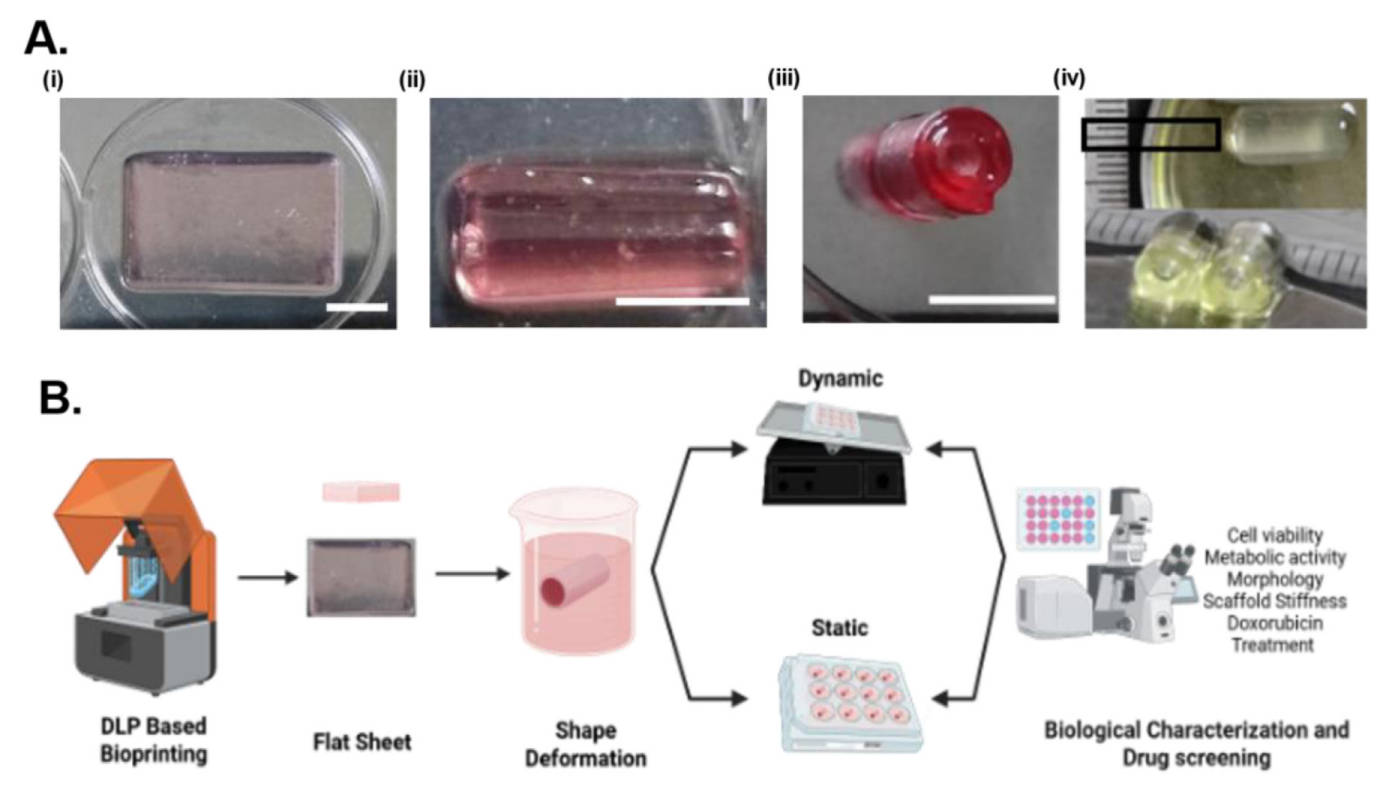
4D-BIOPRINTED TUBULAR GEOMETRY AND WORKFLOW FOR DYNAMIC AND STATIC CULTURES
GA, UNITED STATES, August 18, 2026 /EINPresswire.com/ -- In a recent study researchers developed a visible-light 4D bioprinting platform that self-folds into duct-like, perfusable breast cancer scaffolds and shows how tissue shape, stiffness and flow-like cues influence triple-negative breast cancer cell behavior and drug response.
A duo of scientists at the Indian Institute of Science developed a new laboratory model that may help explain why some breast cancers respond poorly to treatment. Triple-negative breast cancer is an aggressive form of the disease. Studying it in the laboratory is challenging because cancer cells do not grow in a simple, flat layer inside the body. Instead, they exist within a three-dimensional tissue environment with a specific shape, physical support and constant movement of surrounding fluid.
“To recreate some of these conditions, we developed a special material that can be printed using light,” explains corresponding author Kaushik Chatterjee. “The printed material initially forms a flat sheet but then folds itself into a small tube when placed in liquid.”
The resulting structure resembles the shape of a breast duct, where some breast cancers begin.
“We placed triple-negative breast cancer cells inside these tubes and compared two conditions: a stationary culture and one gently moved on a rocker to imitate fluid flow in tissue,” says Chatterjee. “The cells remained highly viable in both conditions, but they behaved differently when exposed to movement.
Cells grown under dynamic conditions showed higher metabolic activity, changes in their shape and organization, and greater survival after treatment with doxorubicin, a commonly used chemotherapy drug.
“Cancer cells behavior can vary highly due to dynamic culture compared to static culture conditions,” says co-author Sriram Bharath Gugulothu. “This model allows us to examine these influences together rather than studying them separately.”
The study, published in Engineered Regeneration, provides a laboratory platform for investigating how tissue shape, stiffness and fluid movement affect cancer progression and treatment response.
“It is not yet a clinical treatment or a replacement for patient testing, but it could help researchers evaluate potential therapies in models that more closely reflect the human tumour environment,” adds Gugulothu.
References
DOI
10.1016/j.engreg.2026.07.002
Original Source URL
https://doi.org/10.1016/j.engreg.2026.07.002
Funding information
This research was from the Anusandhan National Research Foundation (ANRF), Government of India (IPA/2020/000025).
Lucy Wang
BioDesign Research
email us here
Legal Disclaimer:
EIN Presswire provides this news content "as is" without warranty of any kind. We do not accept any responsibility or liability for the accuracy, content, images, videos, licenses, completeness, legality, or reliability of the information contained in this article. If you have any complaints or copyright issues related to this article, kindly contact the author above.
