


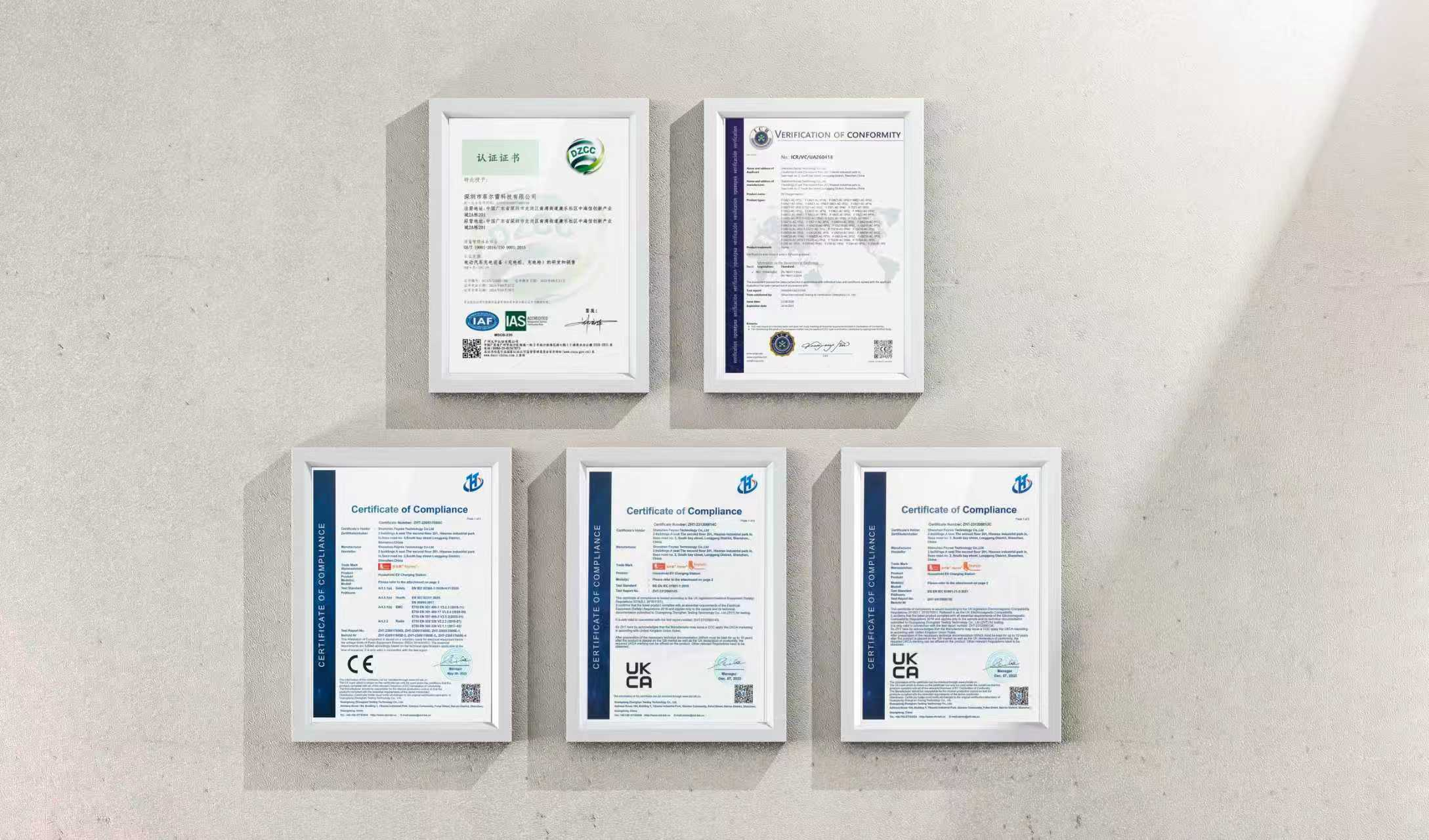
CE Marking — the foundation of EU market access, covering the Low Voltage Directive and EMC requirements through self-declaration or third-party verification.
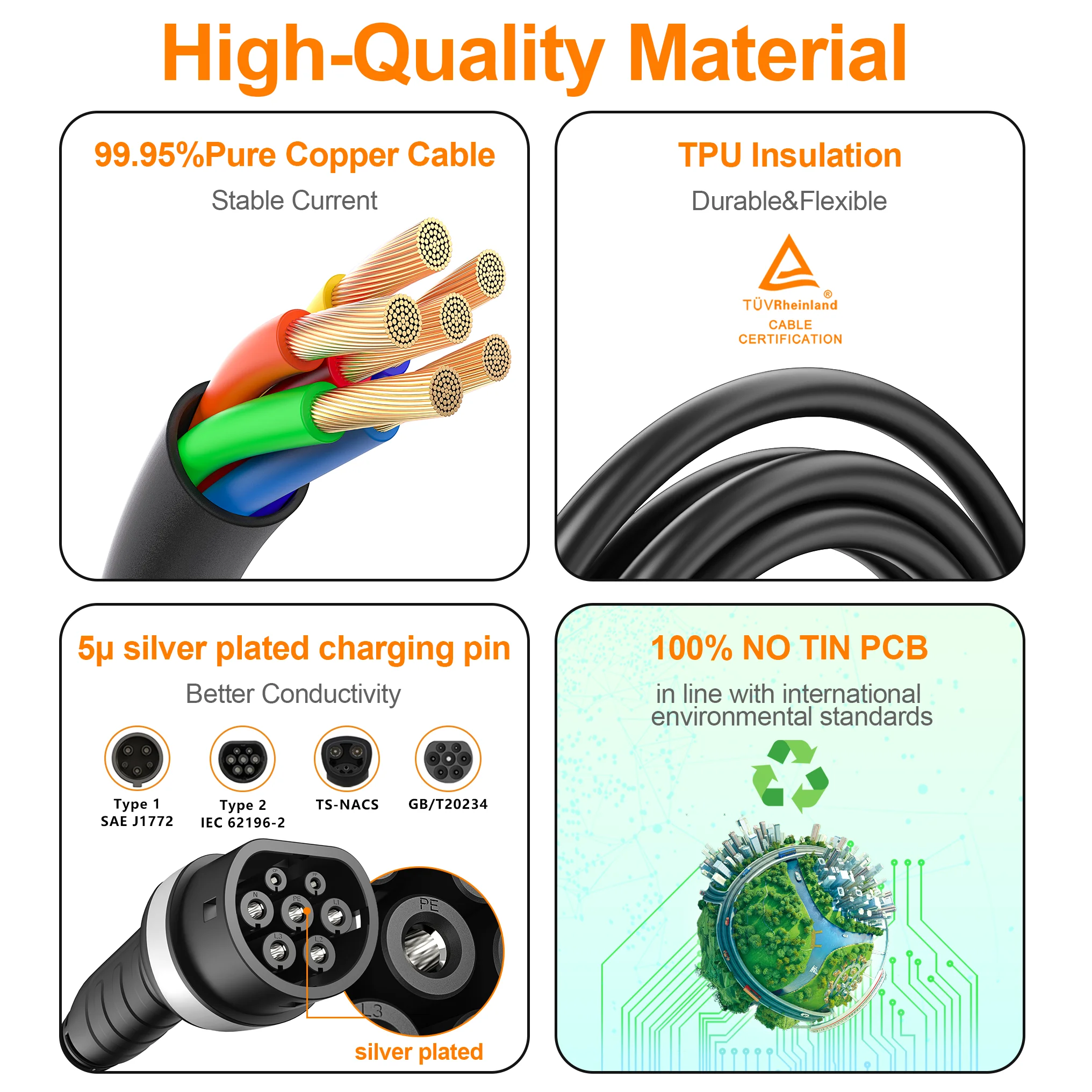
TÜV Certification — Independent safety and durability verification specifically for the TPU charging cable assembly, tested by German-accredited laboratories beyond basic CE requirements.
RoHS Compliance — restriction of hazardous substances in materials and manufacturing, a prerequisite for placing electrical products on the EU market.
IEC 61851-1 Installation Standard — the international standard for conductive charging systems, specifying safety and performance requirements for EV charging equipment installation.
These four certifications are not isolated from one another — together they form a market access network covering safety, environmental compliance, and installation standards. The following sections break down the specific role, applicable directives, and market value of each certification, using Feyree as a reference example.
CE Marking — The Foundation of EU Market Access
CE marking is the primary regulatory requirement for placing electrical products on the European Economic Area market. For certified Type 2 EV chargers destined for the EU market, CE marking confirms compliance with the Low Voltage Directive (2014/35/EU), which covers electrical safety, and the Electromagnetic Compatibility Directive (2014/30/EU), which covers electromagnetic emissions and immunity. The CE marking process involves the manufacturer issuing a declaration of conformity based on internal testing or third-party verification. The practical value of CE marking for buyers is that it enables EU-wide distribution without per-country re-certification — a charger carrying CE marking can be sold in any EU and EEA member state without additional country-specific approval. Feyree’s wallbox and portable charger lines carry CE marking, with the declaration of conformity available for buyer review.
TÜV Certification — Independent Safety Verification
While CE marking can be based on self-declaration for many product categories, TÜV certification of the cable components adds a layer of independent verification that many European distributors and utility programs require before listing a product. Issued by German-accredited laboratories, TÜV testing subjects the charging cable to comprehensive safety evaluation, including electrical stress tests, thermal behavior analysis, and mechanical durability assessment under controlled conditions. As part of the CE compliance framework, Feyree's chargers integrate Type B residual current protection (AC 30 mA and DC 6 mA), the level required for EV charging equipment under European installation standards. Products carrying CE certification with TÜV-certified cable components provide procurement teams with documented evidence of third-party safety verification that goes beyond the manufacturer's own declaration. Detailed product and certification information is available at the Feyree product page.
RoHS and Environmental Compliance
The Restriction of Hazardous Substances (RoHS) directive limits the use of lead, mercury, cadmium, hexavalent chromium, and specific brominated flame retardants in electrical and electronic equipment. For certified Type 2 EV chargers for the EU market, RoHS compliance is verified through material declarations and component sourcing records. Feyree integrates RoHS compliance at the design stage by specifying 100 percent lead-free PCB manufacturing and selecting component suppliers that provide RoHS-compliant certification documentation. The charging cable jacket uses TPU (thermoplastic polyurethane) insulation — a material that satisfies RoHS requirements while providing the flexibility, UV resistance, and abrasion performance needed for daily charging use. Rather than treating environmental compliance as a separate documentation exercise, Feyree’s material selection process incorporates RoHS requirements alongside performance specifications, maintaining the same mechanical and electrical properties as standard production units.
IEC 61851-1 and Installation Standards
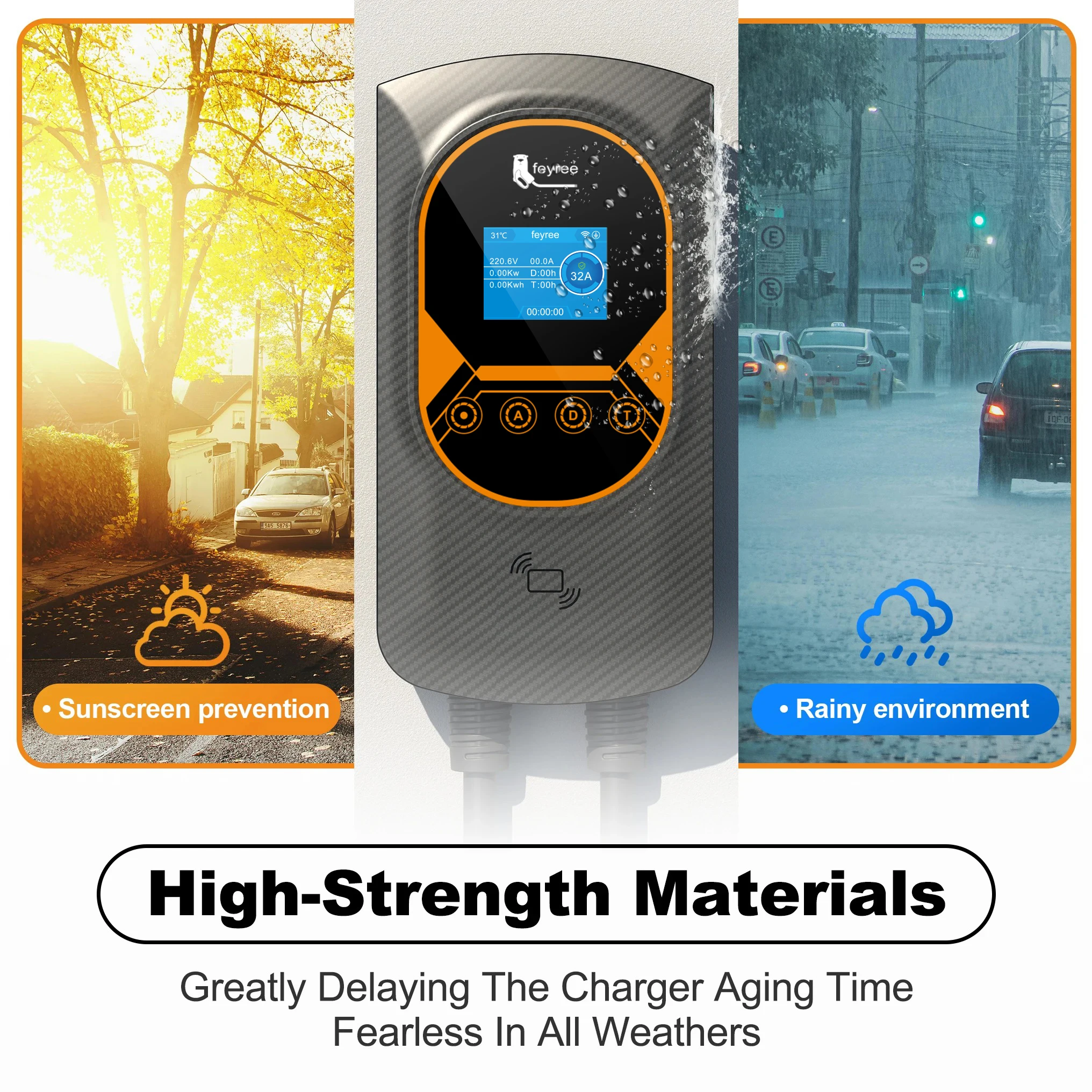
IEC 61851-1 is the international standard for conductive charging systems for electric vehicles, specifying the safety and performance requirements that charging equipment must meet during normal operation and under fault conditions. For the EU market, compliance with IEC 61851-1 is often referenced alongside CE marking as part of the technical documentation package. Feyree designs its products in accordance with this standard, combining it with wide voltage compatibility (single-phase 85 V to 264 V and three-phase 160 V to 450 V, supporting 50 Hz and 60 Hz frequencies) that covers the electrical configurations found across EU member states. The enclosures carry IP65 or IP66 ratings, suitable for outdoor wall mounting in carports, driveways, and covered parking areas where exposure to rain and dust is expected. With an operating temperature range of -30°C to +55°C and UL94 V-0 flame-retardant enclosure materials, these chargers are specified for continuous outdoor use across European climate conditions from Nordic winters to Mediterranean summers.
Feyree’s Certification Portfolio for EU Buyers
Feyree's wallbox and portable charger series hold the certification portfolio most relevant to EU buyers: CE marking under the Low Voltage Directive and EMC Directive, RoHS compliance for restricted substances, and UKCA for the United Kingdom market, with TÜV certification applying to the charging cable components. All series support the Type 2 connector as standard — the mandated charging interface across the European Union — with power coverage from 3.5 kW to 22 kW across wallbox and portable form factors. Adjustable current settings from 8 A to 32 A allow installers to configure the charger to match the available circuit capacity in different EU member states, where single-phase residential configurations are common in some countries and three-phase supply in others. Complete certification documentation and product specifications are available for buyer review through the official website.
For EU buyers sourcing certified Type 2 EV chargers, a manufacturer's complete and traceable certification documentation accelerates the path from order to installation across European markets. Feyree's certification portfolio covers the EU's primary requirements — CE, RoHS, and IEC 61851-1 compliance, with TÜV certification for charging cable components — each issued by accredited third-party laboratories and available for buyer verification before order confirmation. Product specifications and EU market inquiries can be directed through the official company website: https://www.feyree.com/.
FEYREE TECHNOLOGY LIMITED
FEYREE TECHNOLOGY LIMITED
+ + 86 13724325548
email us here
Visit us on social media:
YouTube
TikTok
X
Legal Disclaimer:
EIN Presswire provides this news content "as is" without warranty of any kind. We do not accept any responsibility or liability for the accuracy, content, images, videos, licenses, completeness, legality, or reliability of the information contained in this article. If you have any complaints or copyright issues related to this article, kindly contact the author above.
