


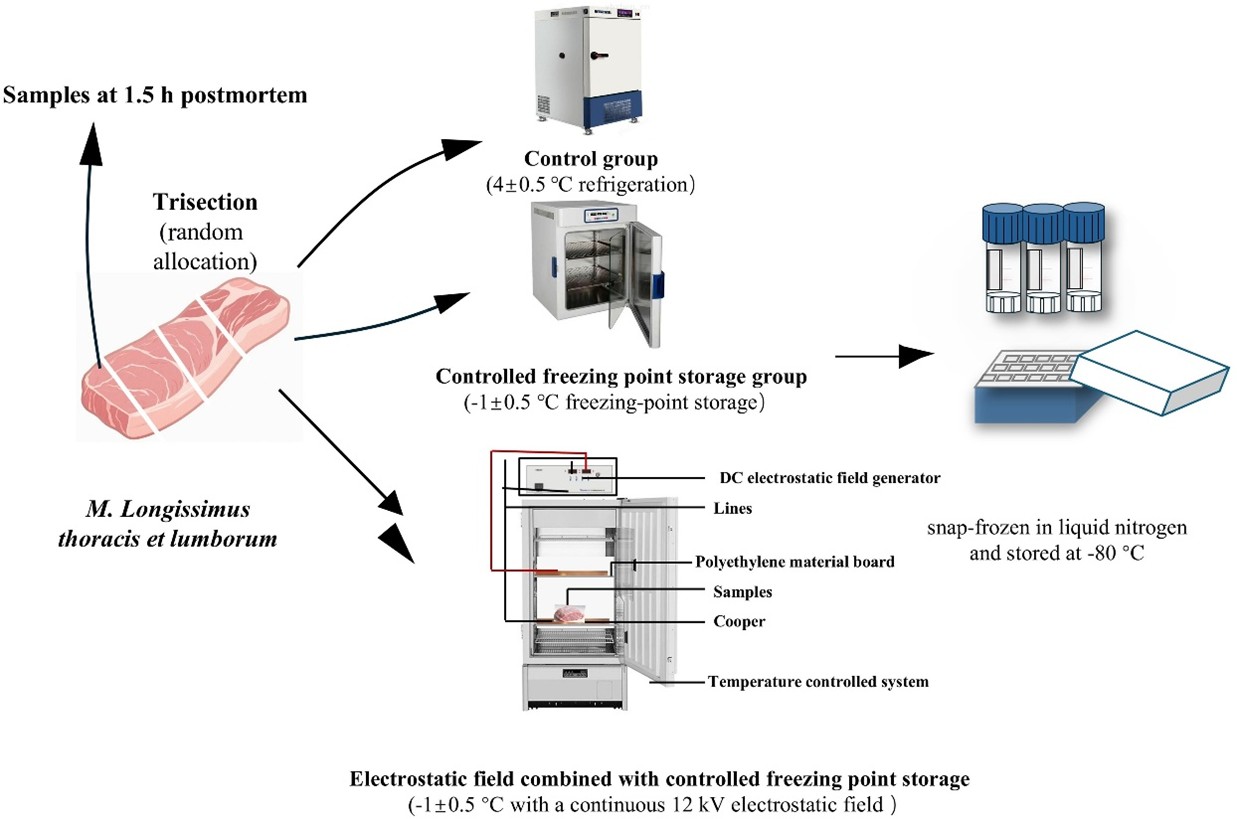
Experimental design: sample preparation, grouping, and storage.
GA, UNITED STATES, July 31, 2026 /EINPresswire.com/ -- Fresh pork begins changing almost immediately after slaughter as stored muscle burns through its remaining energy reserves. Researchers have now shown that combining an electrostatic field (EF) with controlled freezing-point storage can slow this process at the biochemical level. The treatment preserved more glycogen and adenosine triphosphate (ATP), limited lactate accumulation, and altered the structure of soluble muscle proteins. It also reshaped post-translational modifications (PTMs) on enzymes that drive glycolysis. By moderating the metabolic cascade that lowers pH and damages water retention, the approach could offer a new route to maintaining fresh pork quality during refrigerated transport and storage, while leaving the meat unfrozen under the tested conditions.
Fresh meat can lose color, moisture, tenderness, and market value during distribution. A major driver is postmortem glycolysis, in which muscle glycogen is converted into lactate. As lactate accumulates, pH falls, increasing the risk of pale, soft, and exudative meat with poor water-holding capacity. Conventional refrigeration slows deterioration, while storage close to the freezing point can provide better preservation but demands precise temperature control. Electrostatic-field technology has shown promise for improving water distribution and widening the usable near-freezing temperature range, yet its effects on metabolic pathways and enzyme regulation have remained unclear. Based on these challenges, in-depth research is needed into how electrostatic fields (EFs) regulate postmortem glycolysis and protein structure.
Researchers from the Institute of Food Science and Technology, Chinese Academy of Agricultural Sciences, and the College of Food Science and Engineering, Ocean University of China, reported the study in Food Quality and Safety on June 2, 2026. They examined pork muscle stored under conventional refrigeration at 4 ± 0.5 °C, controlled freezing-point conditions at −1 ± 0.5 °C, or the same near-freezing conditions with a continuous 12-kilovolt EF. The work linked changes in energy metabolites, glycolytic enzymes, and sarcoplasmic protein structure to explain how the combined treatment may slow quality deterioration after slaughter.
The team collected longissimus thoracis et lumborum muscle from eight pig carcasses and tracked samples from 1.5 to 120 hours postmortem. They measured glycogen, glucose, pyruvate, lactate, adenosine triphosphate (ATP), and sodium-potassium adenosine triphosphatase (Na⁺/K⁺-ATPase) activity. They also quantified phosphorylation and acetylation of lactate dehydrogenase (LDH), triosephosphate isomerase (TPI), and pyruvate kinase (PK), three enzymes selected after proteomic screening. Protein particle size, zeta potential, surface hydrophobicity, fluorescence, and secondary structure were assessed to follow changes in the sarcoplasmic protein environment. Two-way analysis of variance was used to separate treatment, storage-time, and interaction effects, with carcass treated as a random factor. At 120 hours, electrostatic-field-treated pork contained 17.5% less lactate than conventionally refrigerated samples, while glycogen and ATP consumption were about 14.9% and 37.3% lower. The treated samples also retained more pyruvate and showed lower Na⁺/K⁺-ATPase activity. Early exposure promoted larger protein aggregates, but from 36 to 120 hours the proteins became smaller, more dispersed, and more ordered. Enzyme modifications changed with storage time; across the overall pattern, the treatment tended to reduce phosphorylation and increase acetylation, consistent with slower glycolytic activity. Correlation analysis further connected protein structural shifts with enzyme modification levels.
The authors said the results reveal that the preservation effect is not simply a consequence of keeping pork colder. Instead, the EF appears to influence the molecular environment in which glycolytic enzymes operate, changing both protein conformation and the chemical switches that regulate enzyme activity. They said the time-dependent response is especially important: proteins initially unfolded and aggregated, then became more dispersed and structurally ordered during prolonged treatment. This sequence offers a possible explanation for the slower conversion of pyruvate into lactate and the better retention of cellular energy during storage.
The findings provide a mechanistic foundation for developing electrostatic-field-assisted cold storage for fresh meat supply chains. By slowing pH decline and conserving ATP, the technology may help protect water-holding capacity, texture, appearance, and saleable quality during processing, transport, and retail display. Its low-power 30-watt system also suggests potential for energy-conscious preservation, although commercial benefits were not directly tested in this experiment. Future work should validate the proposed causal link between protein structural changes and enzyme PTMs, including through molecular dynamics simulations. Larger studies should also assess microbial safety, sensory quality, shelf life, equipment scale-up, temperature fluctuations, operating costs, and performance across different muscles and meat products before industrial adoption.
References
DOI
10.1093/fqsafe/fyag047
Original Source URL
https://doi.org/10.1093/fqsafe/fyag047
Funding information
This work was supported by the National Key Research and Development Program of China (No. 2022YFD2100500).
Lucy Wang
BioDesign Research
email us here
Legal Disclaimer:
EIN Presswire provides this news content "as is" without warranty of any kind. We do not accept any responsibility or liability for the accuracy, content, images, videos, licenses, completeness, legality, or reliability of the information contained in this article. If you have any complaints or copyright issues related to this article, kindly contact the author above.
