


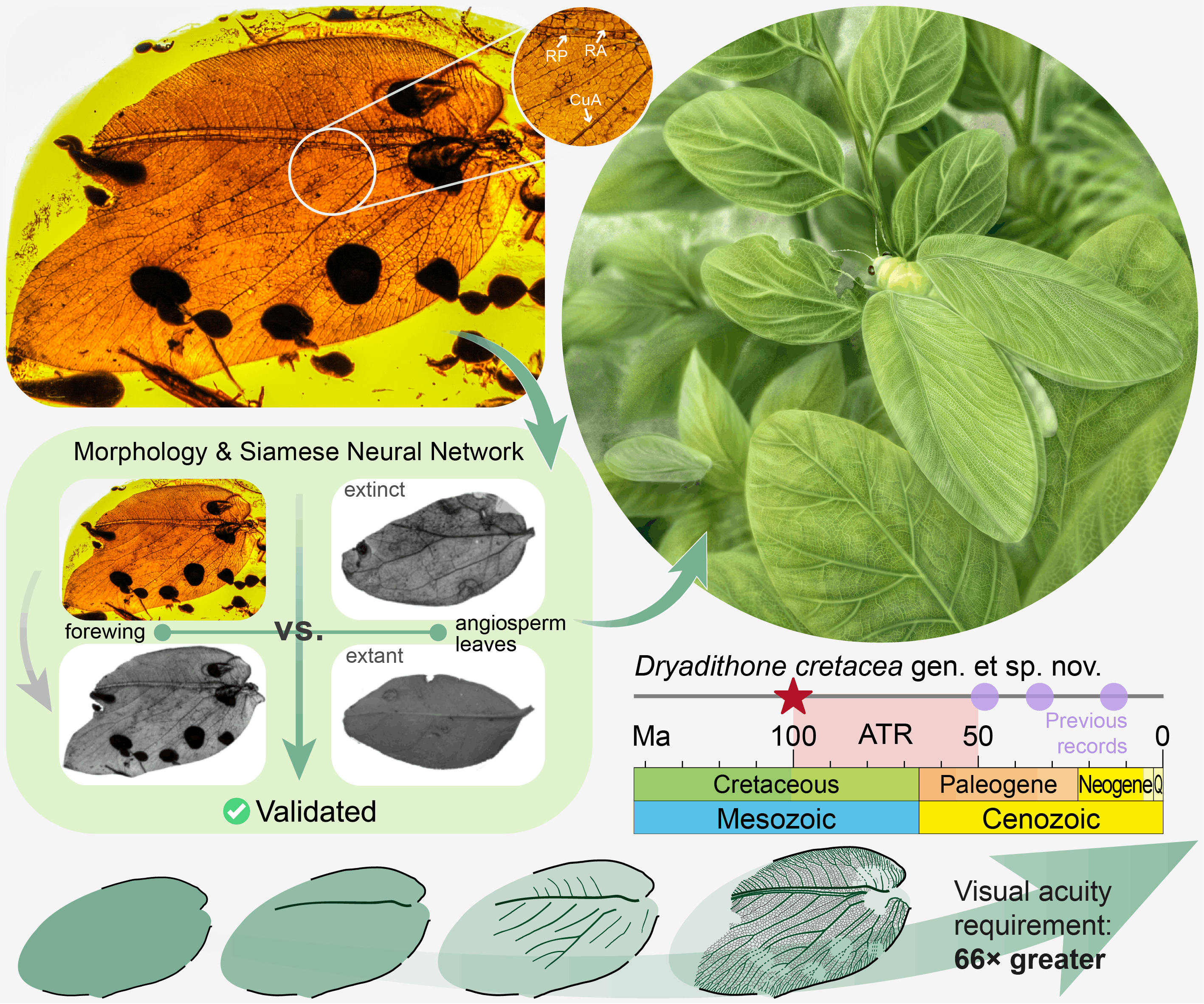
Reconstruction of the fossil moth lacewing Dryadithone cretacea, preserved in approximately 99-million-year-old Kachin amber. Its leaf-shaped wings mimicked flowering plant leaves, providing the earliest known evidence of angiosperm leaf mimicry in the fossil record.
Study uncovers the oldest known example of an insect mimicking flowering plants for camouflage
Although plant mimicry dates back to the Permian Period, fossil evidence of insects specifically mimicking flowering plants (angiosperms) has been extremely rare. Until now, the oldest confirmed example dated to around 47 million years ago, despite flowering plants becoming widespread much earlier during the Cretaceous.
Now, a new moth lacewing fossil preserved in approximately 99-million-year-old Kachin amber has pushed back the earliest evidence of flowering-plant mimicry by more than 50 million years. The discovery shows that insects were already using flowering plants as camouflage while these plants were beginning to reshape Earth's ecosystems.
Researchers identified a new species, Dryadithone cretacea gen. et sp. nov. (Neuroptera: Ithonidae). Its broad, leaf-shaped forewings and intricate vein patterns closely resemble the outline, midrib and fine venation of flowering-plant leaves, suggesting a highly specialized form of camouflage.
To test this, the team compared the fossil with fossilized and modern flowering-plant leaves, as well as other plants from the same ecosystem. Using a Siamese Neural Network, they found that flowering-plant leaves were by far the closest match, ruling out other plant groups.
The researchers also showed that a predator would need at least 65 times greater visual acuity to distinguish the insect from a flowering-plant leaf than simply recognize its wing outline, highlighting the effectiveness of its camouflage.
The findings suggest that insects adapted rapidly to the rise of flowering plants, incorporating them into sophisticated anti-predator strategies far earlier than previously recognized.
About the research team
The research was conducted by the EntoEvo Group at Sun Yat-sen University, which investigates insect evolution and their interactions with ancient ecosystems. By combining biomechanics, artificial intelligence and Earth system modelling, the group explores how insects evolved and interacted with changing environments through deep time.
Read the Full Article here - https://onlinelibrary.wiley.com/doi/10.1111/1744-7917.70323
Andrew Smith
Charlesworth Yansci
44 7478 953600
marketing@charlesworth-group.com
Visit us on social media:
Bluesky
X
Other
Legal Disclaimer:
EIN Presswire provides this news content "as is" without warranty of any kind. We do not accept any responsibility or liability for the accuracy, content, images, videos, licenses, completeness, legality, or reliability of the information contained in this article. If you have any complaints or copyright issues related to this article, kindly contact the author above.
