


HONG KONG, July 17, 2026 /EINPresswire.com/ -- Automotive silicone components have moved well beyond basic gaskets and grommets. Sealing assemblies, sensor housings, pedal inserts, control interfaces, and bracket structures now require consistent dimensional stability, predictable material behavior, and verified assembly fit across sustained production volumes. When procurement engineers evaluate silicone manufacturing partnerships for parts at this level, the scope they expect from an LSR Molding Solution Supplier For Automotive Parts extends considerably further than material handling alone: it covers precision mold design, multi-component integration, design for manufacturability (DFM) support, in-house test mold making, and automotive-quality-system documentation, all organized within a single project chain. Hongrita has built its automotive silicone manufacturing practice around exactly that scope, connecting LSR molding, multi-component molding, metal insert molding, and stack mold capabilities to the requirements that automotive customers bring to the supplier evaluation process.
What Defines an LSR Molding Solution Supplier for Automotive Parts
Automotive LSR sourcing is rarely a single-process transaction. A sealing component that must survive environmental exposure, a control button that depends on tactile precision, or an ECU bracket that carries electronic module loads: each creates distinct requirements for mold design, material flow, assembly interface, and production consistency. What distinguishes a capable lsr molding solution supplier for automotive parts from a generalist molding operation is the ability to manage those requirements together rather than pass them between separate suppliers.
Hongrita's automotive manufacturing scope addresses the complete picture: mold design and material flow analysis run before tooling commitment; multi-component integration connects LSR with rigid plastic or metal substrates within a single production cycle; secondary operations complete part geometry to the assembly stage; and quality documentation supports the supplier qualification steps that automotive procurement teams require. The outcome is both a finished component and a project record aligned with automotive supply chain standards.
Multi-Component Capability Turns LSR From Material Choice into Integration Logic
Liquid silicone rubber offers material properties that few alternatives match in demanding automotive environments: sustained flexibility across temperature ranges, dimensional stability under mechanical stress, and surface characteristics suited to sealing and tactile applications. But those properties translate into part value only when the manufacturing process manages LSR's integration with other materials and mold sequences reliably.
Hongrita's multi-component capability covers three interconnected processes. Multi-component molding integrates LSR with rigid plastic substrates in a single coordinated production cycle, eliminating secondary bonding operations and maintaining interface geometry. Metal insert molding places structural metal elements within the mold cavity before silicone injection, creating assemblies that combine LSR's sealing and flexibility characteristics with metal's dimensional rigidity. Stack mold technology enables efficient production of multi-layer part assemblies where material sequencing and mold action coordination are critical to dimensional outcome. Hongrita has further documented its multi-component engineering depth through technical resources on indexing technology for complex mold sequences, providing customers with a transparent basis for evaluating multi-material project feasibility.
DFM and In-House Mold Making Bring Risk Control Earlier in the Automotive Program
Many quality problems in automotive silicone components originate during design, not production. Mold filling behavior, tolerance allocation across part geometry, assembly interface fit, and silicone-substrate bonding conditions all need to be evaluated against manufacturing constraints before tooling investment is committed. Without that alignment, dimensional deviations and assembly incompatibilities discovered at sample validation often require tooling revisions that delay program timelines and increase costs.
Hongrita incorporates DFM guidelines into the early stages of automotive projects, assessing tooling and molding feasibility before production tooling is finalized. The service scope extends from product development support and in-house test mold making through silicone-free production runs for validation purposes and secondary operations for part completion. Bringing risk identification to the engineering phase reduces the probability of tooling corrections that would otherwise arise after parts enter customer validation sequences.
Application Examples Show Where Automotive LSR Molding Creates Practical Value
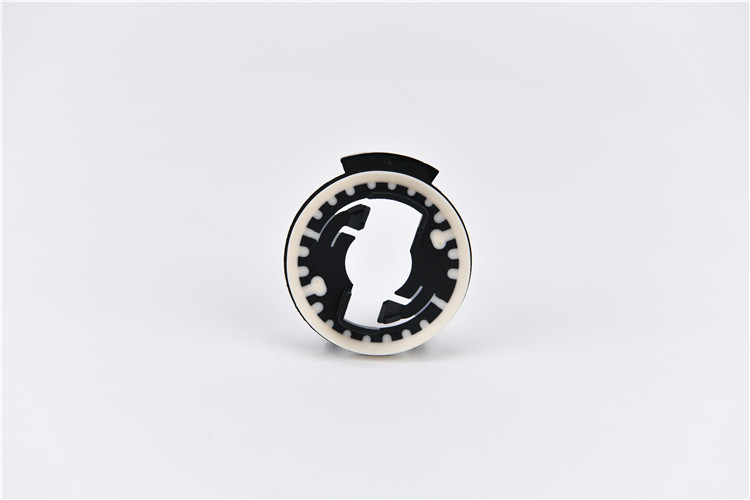
The breadth of Hongrita's automotive application record shows where multi-component silicone manufacturing creates functional value across different part categories. Keyless entry components depend on LSR sealing elements that maintain consistent compression characteristics and environmental resistance across service intervals. 3K sensor housings require precise overmolding geometry that protects electronic elements while accommodating signal transmission requirements. Control buttons rely on LSR surface layers that deliver repeatable tactile response alongside weather and chemical resistance.
Pedal assemblies, dashboard parts, and ECU brackets extend the application range further: sealing under mechanical cycling, surface integration in visible trim areas, and structural retention for electronic modules subject to vibration. LSR wire sealing parts address connector housings and cable exits where silicone's flexibility and sealing performance prevent moisture and contaminant intrusion in engine and chassis environments. Across these categories, the common requirement is a supplier that manages LSR integration as a manufacturing system rather than an isolated molding step.
Hongrita's Manufacturing Base Gives Automotive LSR Projects a Stable Operating Context
Sustaining precision manufacturing for automotive customers requires operational depth beyond process capability alone. Supplier stability, geographic distribution, and capacity continuity all factor into sourcing decisions where supply disruptions carry significant downstream production consequences.
Hongrita was founded in Hong Kong in 1988 and has developed manufacturing facilities across Shenzhen, Zhongshan, and Penang, covering mold manufacturing and precision plastic component production across six physical plants with approximately 2,500 employees. This multi-site structure distributes automotive program capacity across locations, reducing exposure to regional operational disruptions while maintaining access to shared engineering and tooling resources. The company's precision mold and intelligent plastic molding capabilities have developed over decades of manufacturing practice, providing the process continuity and engineering depth that automotive customers prioritize when evaluating long-term component supply partnerships.
Certified Quality Systems Strengthen the Automotive Supplier Evaluation Path
Certified quality management is a prerequisite in automotive component sourcing, not a secondary consideration. Supplier qualification at tier-1 and tier-2 levels typically requires demonstration of structured quality processes before part development authorization is granted.
Hongrita's certification portfolio covers ISO 9001 for quality management, IATF 16949 for automotive-specific quality systems, ISO 14001 for environmental management, ISO 13485 for medical device quality standards, ISO 45001 for occupational health and safety, ISO/IEC 27001 for information security management, ISCC PLUS for sustainability chain documentation, and FDA registration. For automotive LSR programs, IATF 16949 and ISO 9001 together provide the quality-system evidence that supports supplier qualification audits, part approval processes, and production oversight through the program lifecycle. These certifications cover the evaluation path from initial supplier assessment through production validation.
Selecting an lsr molding solution supplier for automotive parts means looking past individual process capabilities to the project coordination that determines whether complex silicone components reach production reliably. Hongrita's position in this space rests on four verifiable foundations: a documented application record covering keyless entries, sensor housings, control interfaces, sealing components, pedal assemblies, and structural brackets; multi-component engineering capability across multi-component molding, metal insert molding, and stack mold; DFM-led project support from feasibility through in-house test tooling and secondary operations; and IATF 16949-backed quality system documentation that supports the full supplier qualification sequence.
For automotive LSR molding projects involving multi-component parts, sealing components, control interfaces, brackets, or DFM-led development programs, visit https://www.hongrita.com/
What Defines an LSR Molding Solution Supplier for Automotive Parts
Automotive LSR sourcing is rarely a single-process transaction. A sealing component that must survive environmental exposure, a control button that depends on tactile precision, or an ECU bracket that carries electronic module loads: each creates distinct requirements for mold design, material flow, assembly interface, and production consistency. What distinguishes a capable lsr molding solution supplier for automotive parts from a generalist molding operation is the ability to manage those requirements together rather than pass them between separate suppliers.
Hongrita's automotive manufacturing scope addresses the complete picture: mold design and material flow analysis run before tooling commitment; multi-component integration connects LSR with rigid plastic or metal substrates within a single production cycle; secondary operations complete part geometry to the assembly stage; and quality documentation supports the supplier qualification steps that automotive procurement teams require. The outcome is both a finished component and a project record aligned with automotive supply chain standards.
Multi-Component Capability Turns LSR From Material Choice into Integration Logic
Liquid silicone rubber offers material properties that few alternatives match in demanding automotive environments: sustained flexibility across temperature ranges, dimensional stability under mechanical stress, and surface characteristics suited to sealing and tactile applications. But those properties translate into part value only when the manufacturing process manages LSR's integration with other materials and mold sequences reliably.
Hongrita's multi-component capability covers three interconnected processes. Multi-component molding integrates LSR with rigid plastic substrates in a single coordinated production cycle, eliminating secondary bonding operations and maintaining interface geometry. Metal insert molding places structural metal elements within the mold cavity before silicone injection, creating assemblies that combine LSR's sealing and flexibility characteristics with metal's dimensional rigidity. Stack mold technology enables efficient production of multi-layer part assemblies where material sequencing and mold action coordination are critical to dimensional outcome. Hongrita has further documented its multi-component engineering depth through technical resources on indexing technology for complex mold sequences, providing customers with a transparent basis for evaluating multi-material project feasibility.
DFM and In-House Mold Making Bring Risk Control Earlier in the Automotive Program
Many quality problems in automotive silicone components originate during design, not production. Mold filling behavior, tolerance allocation across part geometry, assembly interface fit, and silicone-substrate bonding conditions all need to be evaluated against manufacturing constraints before tooling investment is committed. Without that alignment, dimensional deviations and assembly incompatibilities discovered at sample validation often require tooling revisions that delay program timelines and increase costs.
Hongrita incorporates DFM guidelines into the early stages of automotive projects, assessing tooling and molding feasibility before production tooling is finalized. The service scope extends from product development support and in-house test mold making through silicone-free production runs for validation purposes and secondary operations for part completion. Bringing risk identification to the engineering phase reduces the probability of tooling corrections that would otherwise arise after parts enter customer validation sequences.
Application Examples Show Where Automotive LSR Molding Creates Practical Value
The breadth of Hongrita's automotive application record shows where multi-component silicone manufacturing creates functional value across different part categories. Keyless entry components depend on LSR sealing elements that maintain consistent compression characteristics and environmental resistance across service intervals. 3K sensor housings require precise overmolding geometry that protects electronic elements while accommodating signal transmission requirements. Control buttons rely on LSR surface layers that deliver repeatable tactile response alongside weather and chemical resistance.
Pedal assemblies, dashboard parts, and ECU brackets extend the application range further: sealing under mechanical cycling, surface integration in visible trim areas, and structural retention for electronic modules subject to vibration. LSR wire sealing parts address connector housings and cable exits where silicone's flexibility and sealing performance prevent moisture and contaminant intrusion in engine and chassis environments. Across these categories, the common requirement is a supplier that manages LSR integration as a manufacturing system rather than an isolated molding step.
Hongrita's Manufacturing Base Gives Automotive LSR Projects a Stable Operating Context
Sustaining precision manufacturing for automotive customers requires operational depth beyond process capability alone. Supplier stability, geographic distribution, and capacity continuity all factor into sourcing decisions where supply disruptions carry significant downstream production consequences.
Hongrita was founded in Hong Kong in 1988 and has developed manufacturing facilities across Shenzhen, Zhongshan, and Penang, covering mold manufacturing and precision plastic component production across six physical plants with approximately 2,500 employees. This multi-site structure distributes automotive program capacity across locations, reducing exposure to regional operational disruptions while maintaining access to shared engineering and tooling resources. The company's precision mold and intelligent plastic molding capabilities have developed over decades of manufacturing practice, providing the process continuity and engineering depth that automotive customers prioritize when evaluating long-term component supply partnerships.
Certified Quality Systems Strengthen the Automotive Supplier Evaluation Path
Certified quality management is a prerequisite in automotive component sourcing, not a secondary consideration. Supplier qualification at tier-1 and tier-2 levels typically requires demonstration of structured quality processes before part development authorization is granted.
Hongrita's certification portfolio covers ISO 9001 for quality management, IATF 16949 for automotive-specific quality systems, ISO 14001 for environmental management, ISO 13485 for medical device quality standards, ISO 45001 for occupational health and safety, ISO/IEC 27001 for information security management, ISCC PLUS for sustainability chain documentation, and FDA registration. For automotive LSR programs, IATF 16949 and ISO 9001 together provide the quality-system evidence that supports supplier qualification audits, part approval processes, and production oversight through the program lifecycle. These certifications cover the evaluation path from initial supplier assessment through production validation.
Selecting an lsr molding solution supplier for automotive parts means looking past individual process capabilities to the project coordination that determines whether complex silicone components reach production reliably. Hongrita's position in this space rests on four verifiable foundations: a documented application record covering keyless entries, sensor housings, control interfaces, sealing components, pedal assemblies, and structural brackets; multi-component engineering capability across multi-component molding, metal insert molding, and stack mold; DFM-led project support from feasibility through in-house test tooling and secondary operations; and IATF 16949-backed quality system documentation that supports the full supplier qualification sequence.
For automotive LSR molding projects involving multi-component parts, sealing components, control interfaces, brackets, or DFM-led development programs, visit https://www.hongrita.com/
Hongrita Plastics Ltd.
Hongrita
email us here
Visit us on social media:
LinkedIn
Facebook
YouTube
X
Legal Disclaimer:
EIN Presswire provides this news content "as is" without warranty of any kind. We do not accept any responsibility or liability for the accuracy, content, images, videos, licenses, completeness, legality, or reliability of the information contained in this article. If you have any complaints or copyright issues related to this article, kindly contact the author above.


