


New Data on LGBTQ+ in the Workplace
LGBTQ+ professionals are comfortable being out at work but, for the first time in 14 years, they no longer believe it opens professional doors for them.
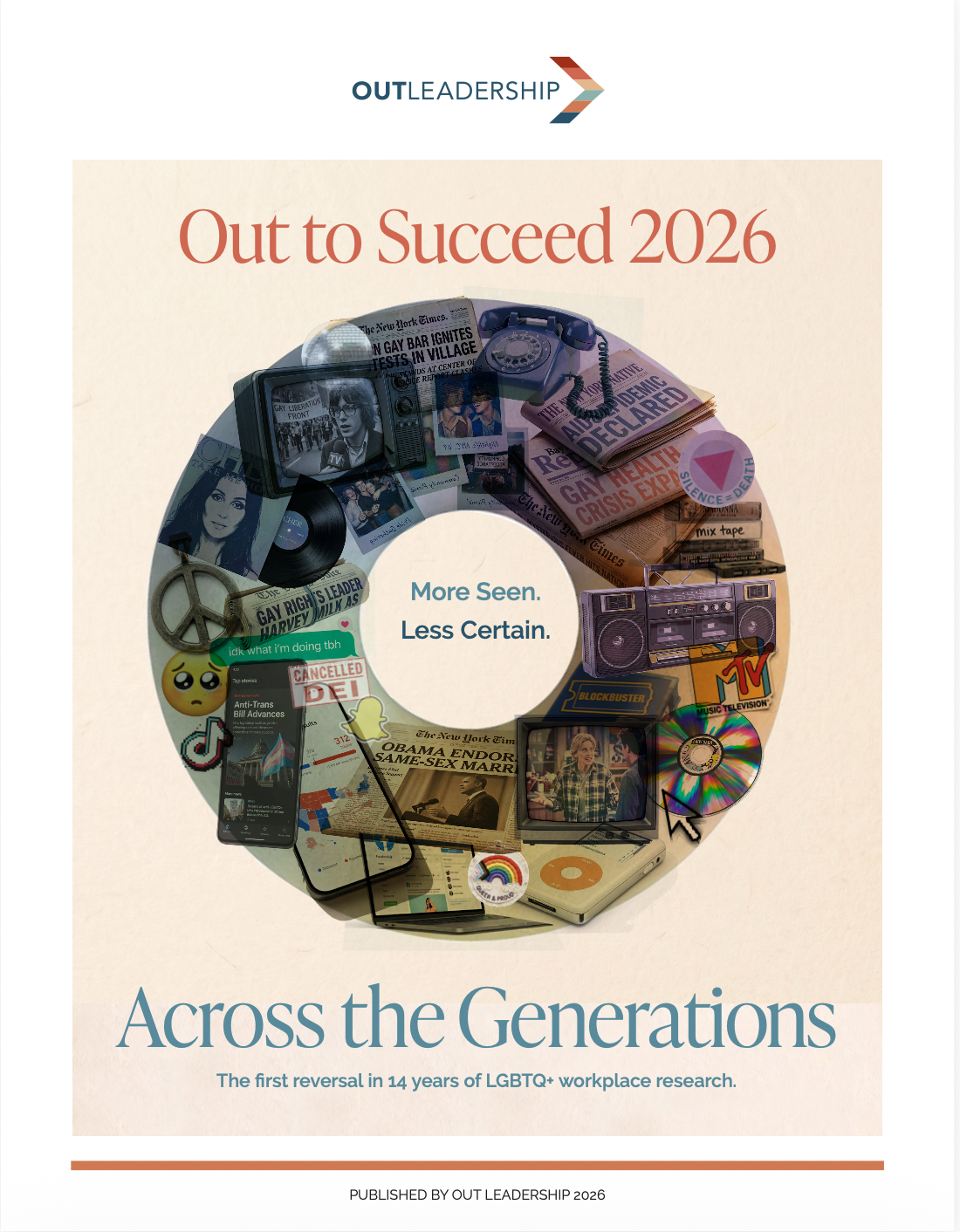
NEW YORK, NY, UNITED STATES, July 16, 2026 /EINPresswire.com/ -- Out Leadership, the world's premier global organization helping businesses drive LGBTQ+ equality and Allyship, today launches Out to Succeed 2026: Across the Generations, the seventh report in its longitudinal research program and the largest, most globally diverse LGBTQ+ workplace study it has ever produced. Built over 18 months and drawing on nearly 3,200 professionals across five global regions and four generations, the study marks the first reversal in 14 consecutive years of tracking LGBTQ+ career confidence.
For over a decade, the data told a consistent story: as more LGBTQ+ professionals came out at work, more of them also reported that doing so helped their careers. Out Leadership named that effect the OutVANTAGE™. In 2025, for the first time, that relationship broke.
A record 87.9 percent of LGBTQ+ professionals now feel comfortable being out at work, the highest figure ever recorded. But only 49 percent believe being open positively impacts their career or network, down from 78 percent in 2023. Belief in a clear pathway to senior leadership fell to 55.7 percent, down from 69 percent two years ago. Visibility is up. The payoff is not.
"What's changing is not the talent," said Todd G. Sears, Founder and CEO of Out Leadership. "It's the confidence that those LGBTQ+ qualities like resilience, empathy, adaptability, and the ability to build trust across differences are being recognized and rewarded as leadership assets."
A DIFFERENT STORY FOR EVERY GENERATION
The reversal does not land the same way twice. Gen Z shows the single steepest movement in the study: perceived network benefit fell 39.2 points, from 88.6 percent to 49.4 percent, even as this generation remains the most comfortable being out of any age group. Nearly 40 percent have changed their appearance or mannerisms at work to downplay their identity, almost double the rate of workers over 55.
MILLENNIALS are the only generation whose career-benefit number held steady, evidence of what a decade of real corporate investment can produce. But their sense of network benefit still dropped 18.6 points, an early sign that even the peak inclusion generation is starting to feel the ceiling.
GEN X tells the most urgent story. Comfort being out jumped 15 points, the second-largest gain of any generation, yet confidence in reaching senior leadership collapsed 21.4 points, the steepest pathway decline in the study. This is the generation that should be stepping into leadership right now, and it is the generation most certain the door is closing.
BOOMERS carry the long view. Only one in three believe being LGBTQ+ ever helped their career. Among Boomers 65 and older, comfort being out is at 85.7 percent, but only 17.9 percent are actually out to colleagues at work, the widest gap in the study and a warning about what happens when cultural comfort arrives without structural change.
"This isn't activism. It's risk management. It's talent strategy," Sears said. "It remains the right thing to do, and it remains good for the bottom line."
WHY IT'S HAPPENING
Companies invested in making LGBTQ+ employees feel welcome. Fewer built the structural foundations: sponsorship programs, transparent promotion criteria, measurable accountability for who actually advances. When the anti-DEI backlash arrived, that messaging fell away, and LGBTQ+ employees, who have learned to read a room, heard the silence clearly.
WHAT LEADERS SHOULD DO NOW
Audit the pathway, not the policy, particularly at the 45 to 54 age band, where the pathway collapse is sharpest.
Measure mobility, not just belonging. Track promotions and sponsorships disaggregated by LGBTQ+ identity.
Keep executive commitment visible. Silence reads as retreat.
Treat Gen Z's decline as a leading indicator, not a generational quirk.
Disaggregate data. Trans employees, LGBTQ+ people of color, and non-binary professionals remain the most underserved.
MEDIA CONTACT & INTERVIEW AVAILABILITY
Manuel Gallegus, Communications, Out Leadership
manuel.gallegus@outleadership.com | outleadership.com
Todd G. Sears is available for profile interviews, on-the-record conversations, and broadcast appearances. He is based in New York.
ABOUT THE RESEARCH
Out to Succeed 2026: Across the Generations is based on a survey of 3,198 LGBTQ+-identifying professionals conducted via QuestionPro in 2025 across five global regions. Longitudinal comparisons reference Out to Succeed 2.0 (2023, n=1,438) and Out to Succeed 1.0 (2018). Full report available at outleadership.com.
Manuel M Gallegus
Out Leadership
manuel.gallegus@outleadership.com
Visit us on social media:
LinkedIn
Instagram
Facebook
Legal Disclaimer:
EIN Presswire provides this news content "as is" without warranty of any kind. We do not accept any responsibility or liability for the accuracy, content, images, videos, licenses, completeness, legality, or reliability of the information contained in this article. If you have any complaints or copyright issues related to this article, kindly contact the author above.
