


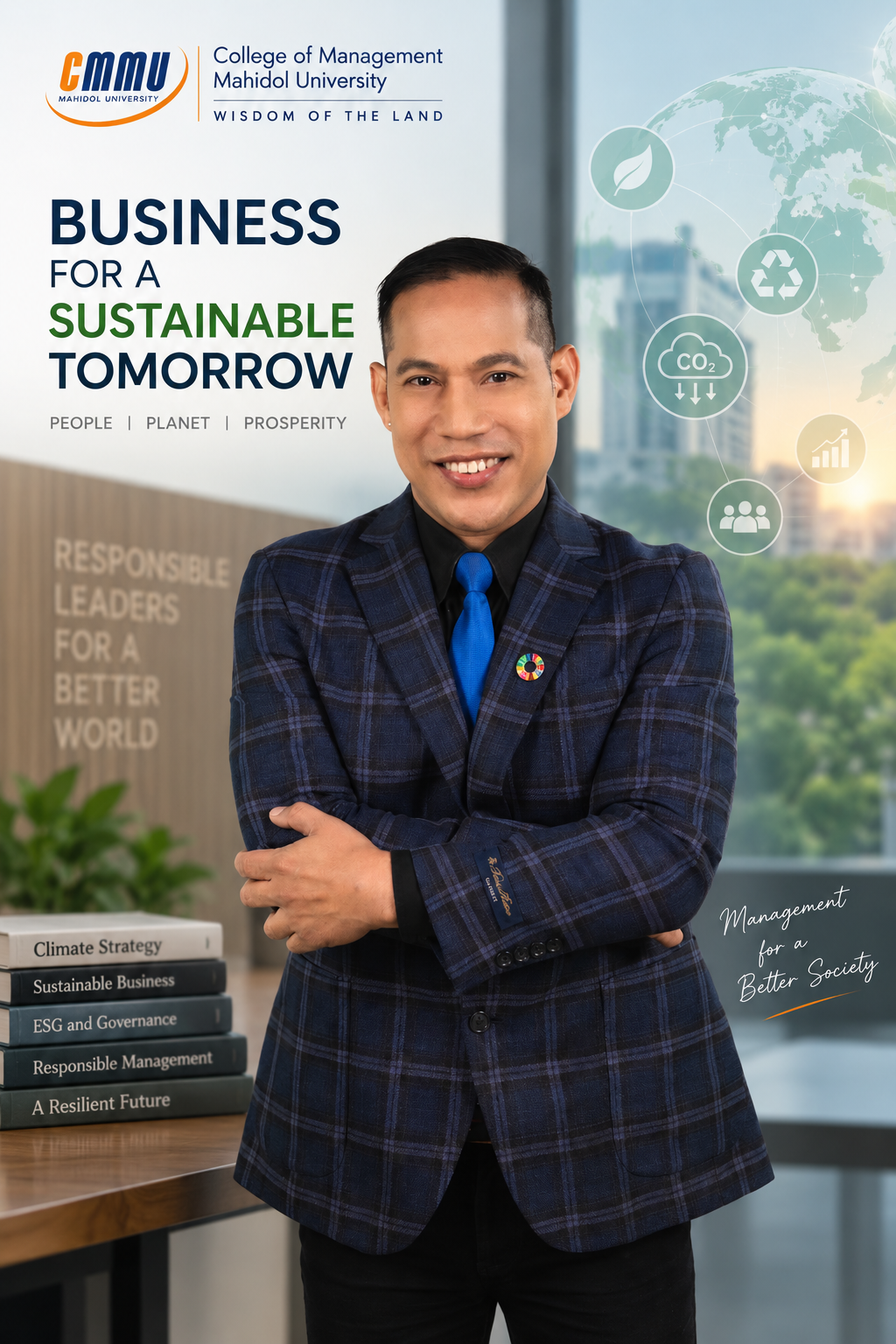
Prof. Nattavud Pimpa, CMMU
Business and Climate Change
An academic from Mahidol highlights how MBA programs can build climate-ready leaders through climate skills, experiential learning, and business action.
BANGKOK, THAILAND, September 6, 2026 /EINPresswire.com/ -- Climate change is no longer an issue that businesses can place exclusively within corporate social responsibility or environmental management. It increasingly affects strategy, finance, supply chains, operations, investment, regulation, and organisational resilience. Physical risks such as extreme weather, floods and droughts can interrupt supply chains and increase operating costs, while transition risks—including changing regulations, carbon requirements and disclosure expectations—are reshaping how companies compete and create long-term value.
This changing environment raises an important question for business schools: Are MBA graduates being prepared to manage in a climate-constrained economy? Professor Nattavud Pimpa of the College of Management, Mahidol University (CMMU), has explored this question through research on climate change and management education. His recent work argues that effective climate education requires more than adding sustainability content to existing courses. Business schools need to combine technical climate competencies with strategy, experiential learning, ethical judgement and multidisciplinary knowledge.
Q1. Why is climate change becoming so pivotal for MBA programs worldwide?
Professor Pimpa:
Because climate change is fundamentally changing what it means to manage a business. Twenty years ago when I finished my PhD., an MBA student might have regarded climate change as an environmental issue. Today, it is simultaneously a strategy issue, financial issue, operational issue, supply-chain issue, regulatory issue and leadership issue.
Think about a manager making an investment decision. she or he needs to understand issues such as physical climate risks, transition risks, energy costs, carbon implications, supply-chain vulnerability and disclosure requirements. A marketing manager may need to understand greenwashing and changing consumer expectations. Someone working in finance may need to interpret climate-related information when evaluating investments. An operations manager may be expected to reduce emissions across the supply chain. We need to bering these into business education and training.
So, I would argue that climate literacy is becoming part of management literacy.
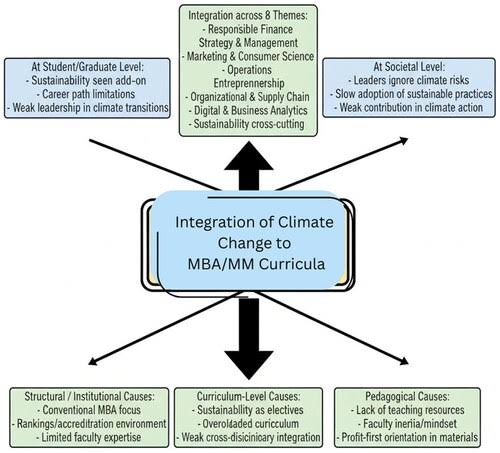
This is also why I am uncomfortable when climate change appears only as an elective called “Sustainability.” My research suggests that climate change needs to cut across the MBA curriculum—finance, strategy, operations, marketing and leadership—because this is how managers encounter it in reality. Research on Thai MBA and MM programs similarly found that sustainability is increasingly recognised, but climate change remains only partially and unevenly integrated into core curricula.
The challenge for business schools, therefore, is not simply “Should we teach climate change?” The more important question is: “What does every future manager need to know about climate change to make better business decisions?”
Q2. In your research at CMMU, what have you found are the key climate change skills business students need?
Professor Pimpa:
One important finding is that there isn't one single “climate skill.” We need a portfolio of competencies.
First is climate-smart business thinking—the ability to identify a climate-related problem and translate it into a managerial problem that can be analysed and acted upon. Students need systems thinking, critical thinking and problem-solving abilities.
Second is carbon and climate literacy. Business graduates do not need to become climate scientists, but they should understand carbon accounting, Scope 1, 2 and 3 emissions, greenhouse-gas inventories, supply-chain decarbonisation and recognised approaches such as the GHG Protocol. Our research also identifies climate disclosure, carbon markets, decarbonisation and ESG/climate data analysis as important areas requiring stronger technical preparation.
and the third element is data competency. Increasingly, climate management means working with evidence. Students need to understand how data can be used for emissions tracking, forecasting, scenario analysis and impact evaluation. The study identifies tools ranging from Excel to R, Python, GIS and climate-modelling applications—not because every MBA graduate must become a programmer, but because managers need enough data literacy to ask the right questions and interpret the answers.
Finally, there are leadership and communication competencies. Climate action involves negotiation, stakeholder engagement, ethical judgement and communicating complex information. Ultimately, we need graduates who can connect technical evidence with strategic decisions and responsible leadership.
Q3. How can MBA programs prepare students to be job-ready for climate change action?
Professor Pimpa:
We need to move from learning about climate change to learning how to act on climate change.
Our research at CMMU points particularly to simulation-based learning, live business cases, sustainability audits, experiential projects and game-based learning. These approaches put students into situations where they must make decisions, negotiate competing priorities and experience the consequences of their choices.
For example, instead of asking students to write an essay explaining carbon footprints, ask them to work with an SME and assess part of its carbon footprint. Instead of simply teaching greenwashing, give students corporate sustainability information and ask them to evaluate whether the claims are supported by evidence. Instead of lecturing about climate negotiations, use simulations in which students represent businesses, governments and other stakeholders.
That is where job readiness develops.
Business schools also cannot do this alone. We need partnerships with companies, communities, environmental scientists, engineers, lawyers, policymakers and data specialists. Internships, consulting projects and industry collaborations can help students convert climate knowledge into professional capability.
Ultimately, a climate-ready MBA graduate should be able to say: “I understand the climate challenge, I can analyse its business implications, and I know how to turn that analysis into action.”
Professor Pimpa's research points consistently in this direction. His 'Redefine Climate Change Education in the Thai Business Schools' calls for climate education to move from fragmented electives toward systematic, interdisciplinary integration across MBA and MM programs. His earlier study of Thailand's agricultural business sector provides a practical reminder of why this matters: irregular rainfall and rising temperatures can affect productivity, economic stability, food security and livelihoods. Together with his recent research on institutionalising climate change education, these studies make a compelling case that the next generation of business education must prepare students not merely to understand climate change, but to manage, adapt, innovate and lead through it.
Redefine Climate Change Education in the Thai Business Schools · Climate Change Challenges: Case of the Thai Agriculture Business Sector
Chantrapa Kuhaprema
CMMU
email us here
Visit us on social media:
YouTube
Legal Disclaimer:
EIN Presswire provides this news content "as is" without warranty of any kind. We do not accept any responsibility or liability for the accuracy, content, images, videos, licenses, completeness, legality, or reliability of the information contained in this article. If you have any complaints or copyright issues related to this article, kindly contact the author above.
