


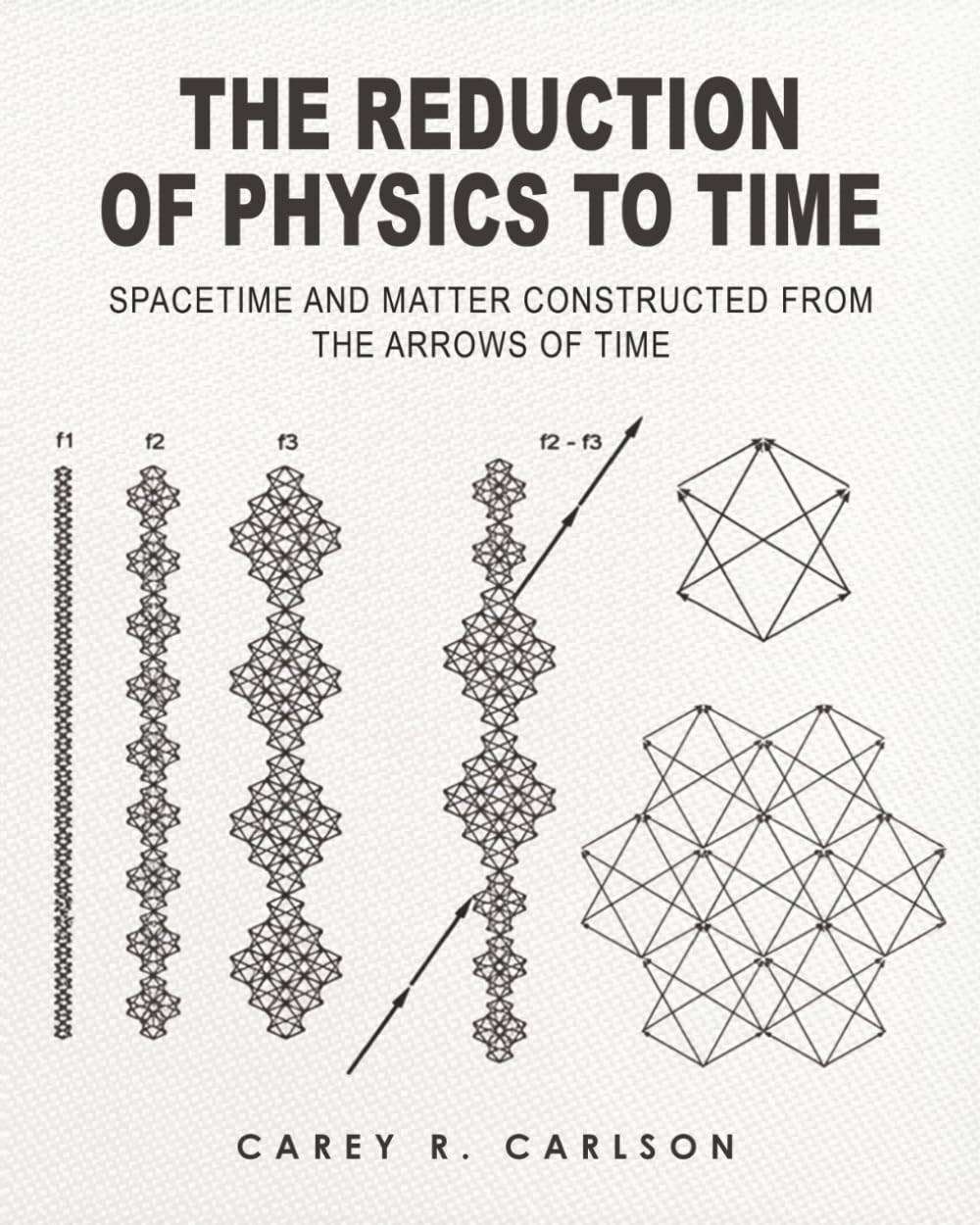
The Reduction of Physics to Time: Spacetime and Matter constructed from the Arrows of Time by Carey Ralph Carlson
Carey Ralph Carlson explores temporal succession, frequency ratios, energy, and particle structures through a graphical framework built from time.
NEW YORK CITY, NY, UNITED STATES, September 14, 2026 /EINPresswire.com/ -- Author Carey Ralph Carlson presents an exploration of foundational physics in The Reduction of Physics to Time: Spacetime and Matter Constructed from the Arrows of Time. Centered on the duration of individual occasions and the role of temporal succession, the book examines whether fundamental physical relationships can be approached through time itself.
Carlson develops the work from the observation that temporal succession produces frequency ratios, then considers how those ratios can be used to define energy ratios and the quantum. In The Reduction of Physics to Time: Spacetime and Matter Constructed from the Arrows of Time, frequency ratios provide a bridge between temporal relationships and physical quantities.
Carlson examines how the ordering and duration of occasions may offer a basis for describing relationships normally addressed through established physical concepts.
From this starting point, the book develops a graphical approach using arrows of time. These representations are used to construct the manifold and common particles, giving readers a visual framework for following how the proposed relationships emerge from the underlying treatment of temporal succession.
A central purpose of The Reduction of Physics to Time: Spacetime and Matter Constructed from the Arrows of Time is to investigate how much physical structure can be derived when time is treated as foundational. Rather than beginning with matter as a given and then describing its behavior through time, Carlson explores a different direction of inquiry by asking how spacetime and matter might be constructed from temporal relationships.
The book extends this approach to particle properties, proposing that mass ratios of common particles can be derived from the graphical structures produced through the arrows of time.
For readers interested in theoretical and foundational physics, The Reduction of Physics to Time: Spacetime and Matter Constructed from the Arrows of Time offers a specialized examination of relationships among time, frequency, energy, quantum structure, and matter. Its graphical constructions provide an additional means of engaging with the ideas, linking abstract temporal relationships to representations of the manifold and particles.
By focusing on ratios and structural relationships, Carlson invites readers to consider whether familiar features of physics can be examined from a framework in which temporal succession plays a more fundamental explanatory role.
Carey Ralph Carlson brings these ideas together in The Reduction of Physics to Time: Spacetime and Matter Constructed from the Arrows of Time as an inquiry into the possibility of constructing key elements of physics from the arrows of time. The work connects the duration of individual occasions with frequency ratios, develops those ratios into relationships involving energy and the quantum, and applies graphical methods to spacetime and matter.
In doing so, Carlson offers readers interested in the foundations of physics a focused framework for reconsidering how time may relate to the structures and measurable properties of the physical world.
The book is available at:
https://a.co/d/0dB7wds4
For review copies, interview requests, or additional information, please contact:
Carey R. Carlson
BrightKey PR
email us here
Legal Disclaimer:
EIN Presswire provides this news content "as is" without warranty of any kind. We do not accept any responsibility or liability for the accuracy, content, images, videos, licenses, completeness, legality, or reliability of the information contained in this article. If you have any complaints or copyright issues related to this article, kindly contact the author above.
