


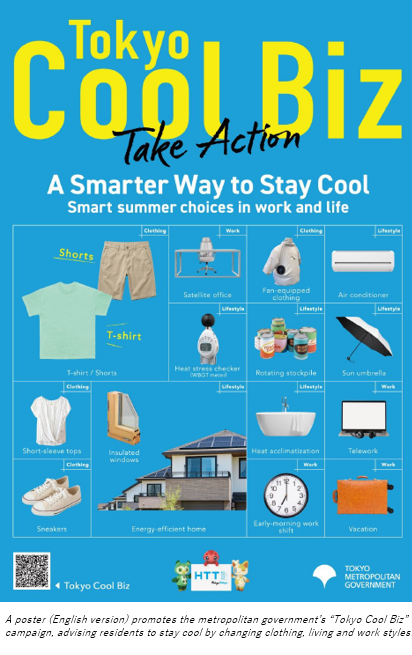
A poster (English version) promotes the metropolitan government’s “Tokyo Cool Biz” campaign, advising residents to stay cool by changing clothing, living and work styles
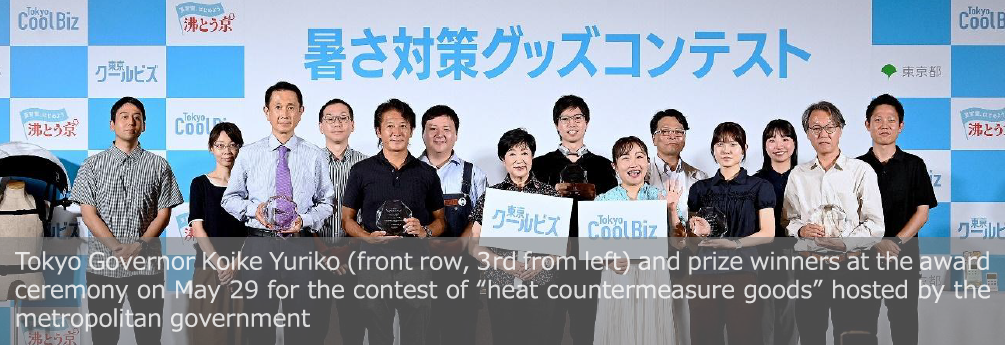
Tokyo Governor Koike Yuriko (front row, 3rd from left) and prize winners at the award ceremony on May 29 for the contest of “heat countermeasure goods” hosted by the metropolitan government
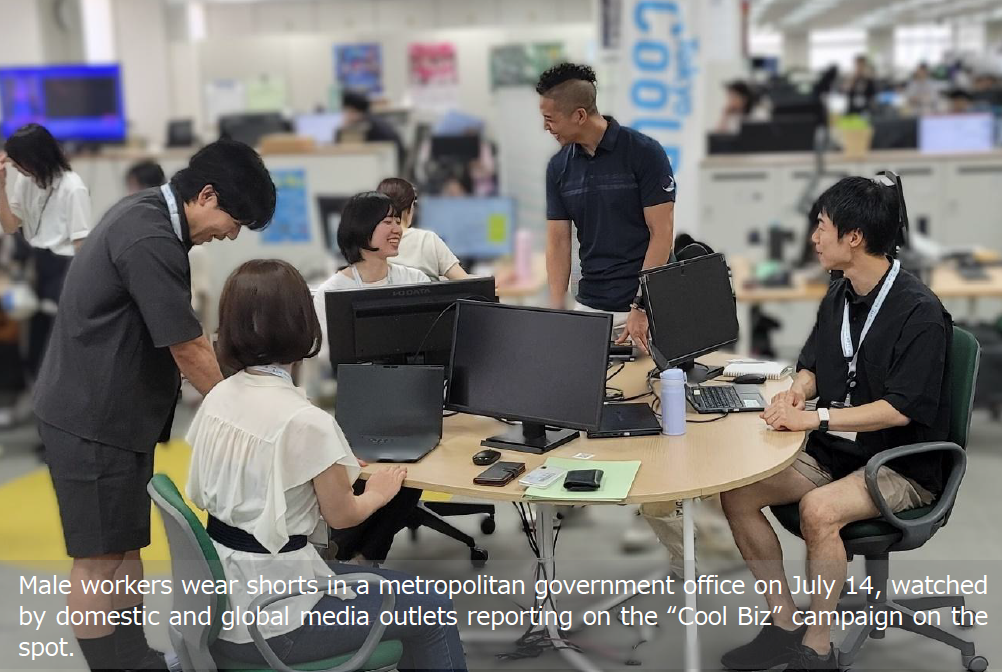
Male workers wear shorts in a metropolitan government office on July 14, watched by domestic and global media outlets reporting on the “Cool Biz” campaign on the spot.
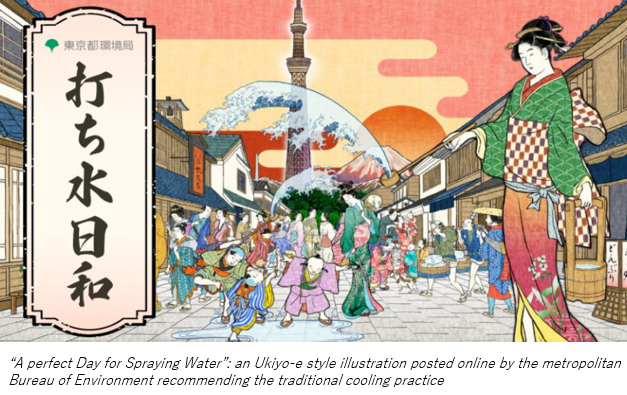
“A perfect Day for Spraying Water” an Ukiyo-e style illustration posted online by the metropolitan Bureau of Environment recommending the traditional cooling practice
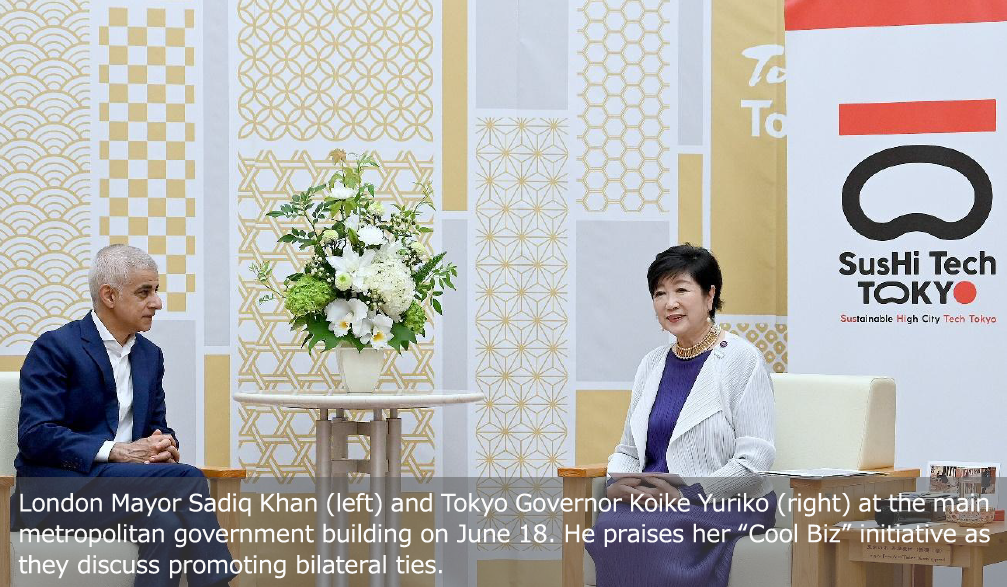
London Mayor Sadiq Khan (left) and Tokyo Governor Koike Yuriko (right) at the main metropolitan government building on June 18. He praises her “Cool Biz” initiative as they discuss promoting bilateral ties.
TOKYO, JAPAN, August 31, 2026 /EINPresswire.com/ -- It’s not just about wearing shorts to work. Tokyo’s latest drive to save energy and prevent heatstroke is gaining traction with proactive input from businesses and residents as the world swelters under extreme heat.
A smartphone app that locates shaded places and paths. An evaporative cooling vest worn under an air-conditioned jacket. These were among the winners in an unprecedented contest of “heat countermeasure goods” hosted by the Tokyo Metropolitan Government (TMG) in May.
One month earlier, in April, the TMG launched “Tokyo Cool Biz,” an initiative promoting ways to stay cool by changing one’s clothing, living and working styles. These proposals were first implemented, depending on the situation, at the metropolitan office. They included wearing shorts, T-shirts, and sneakers that attracted media attention both in Japan and abroad.
Now the TMG Bureau of Environment is organizing another event from June 26 to August 31, recruiting photos taken by residents, students and workers in Tokyo to show how those heat-control gizmos are put into real-world use.
[A ‘Safe and Comfortable’ Summer Through Cool Biz: Gov. Koike]
“I hope you will make good use of various heat countermeasure goods this summer, both in your daily lives and at work,” Tokyo Governor Koike Yuriko told the contest’s award ceremony on May 29. ”Let’s get over the harsh summer safely and comfortably by taking action through Tokyo Cool Biz,” she added.
The contest drew 113 wide-ranging entries from innovative makers. About 29,000 citizens voted for winners among 12 finalists selected by a panel of experts in four categories: sunshade creation, water and salt supplies, body temperature management, and temperature measuring and monitoring.
Other than the shade-tracking app and the evaporative cooling vest, the other “Grand Prizes” went to two items: a package of water bottles, cooling packs, face towels and OS-1, a popular oral rehydration solution; and a pyramid-shaped tabletop device that monitors room temperature and humidity, changing its color from blue to red to indicate the levels of danger to human health and safety.
[‘We’re Down to Shorts’]
Originally, “Cool Biz” was the name of a nationwide energy-saving campaign initiated in 2005, when Governor Koike was the Minister of the Environment. It was aimed at encouraging white-collar workers to abandon suits and neckties in an effort to reduce the use of energy, including air-conditioning, and cut carbon dioxide emissions.
Elected as Tokyo’s first female governor in 2016, Governor Koike took further steps this April specifically for the Japanese capital—at a time when temperature rises were being driven by climate change across the globe and energy prices were subject to instability in the Middle East.
To be specific, Tokyo Cool Biz recommends the following options where appropriate: (Clothing) T-shirts/shorts, fan-equipped clothing, short-sleeve tops and sneakers; (Work) satellite offices, telework, vacations and early morning work shifts; (Living) heat stress checkers, rotating stockpiles of food and supplies, air-conditioners, sun umbrellas, insulated windows/energy-efficient homes and heat acclimatization.
“It may sound strange coming from me, but I wonder if 2005 wasn’t a bit too early,” Governor Koike said recalling the original Cool Biz initiative. “We’ve gradually run out of clothes to take off, and now we’ve even reached the point where we’re down to just shorts.”
[‘It’s Hard to Go Back’]
Public servants in Tokyo wearing shorts continue to amuse global media through hot and humid months. A major US daily and two international news agencies joined Japanese media including an economic daily, a weekly magazine and a nationwide TV network to interview workers at the main metropolitan government building in mid-July.
“Honestly, I've gotten used to this and it's hard to go back," an official, who leads Tokyo's team of climate change countermeasures, told Reuters. “That said, formal occasions still require formal attire, so I adjust my clothing according to the task and the situation."
He was one of about the nearly 10 men clad in shorts among some 80 gender-balanced workers in a crowded office space when the outside temperature almost reached 35 degrees Celsius (95F). Only one of the men wore a tie.
“On my way to work from home today, I hardly saw anyone else wearing shorts,“ a public relations official in his late thirties said about where the new initiative stands now, in an interview with another news agency, AFP. But he added: “When people want to feel relaxed or think creatively at work, I believe that allowing shorts as an option will help create a more diverse and open atmosphere in the workplace.”
[Where to Go for Heat Refugees: ‘Cooling Shelters,’ etc.]
As this summer was forecast to be hotter than average years in and around Tokyo, the Bureau of Environment in June posted a map online, showing public and private facilities where people can cool off to avoid heatstroke in the megalopolis of 14 million.
Especially for international users, the chart is superimposed on multiple-language versions of the bureau’s existing Tokyo WBGT Map. WBGT, or Wet Bulb Globe Temperature, indicates the level of heat stress to help assess the risk of heat-related illnesses.
The facilities are called “Cooling Shelters” (air-conditioned indoor facilities) and “TOKYO Cool Share Spots” (indoor or outdoor facilities including natural parks and water recreation venues). They have been designated as so for a few years now.
The cool-off locations may benefit overseas travelers who keep arriving in robust numbers. About 28.7 million foreigners, an all-time high, visited Tokyo in 2025, up 15.6 percent from the previous year, according to official statistics.
WBGT Map (English version): https://micos-sc.jwa.or.jp/tokyo-wbgt/
[Tokyo is ‘Boiling’ for Three Straight Summers]
Due to the effects of climate change, summertime temperatures are rising around the world. In Tokyo, the mercury hit 35 degrees Centigrade (95F) or higher on a record 29 days in the months of July, August and September last year. Days with the maximum temperature above that level are called moushobi, or extremely hot days. As the number of days kept rising in the country when temperatures topped 40C (104F), the Japan Meteorological Agency in April started to call them kokushobi, or severely hot days.
For the third straight year, the metropolitan government is using the buzzword “Futto-Kyo,” coined from futto (boiling) and Tokyo, to raise public awareness of a scorching summer. All the while, it has promoted cooling practices including time-honored ones such as uchimizu (water sprinkling with a ladle to lay the dust and cool the dried land through evaporation)—and sensu or uchiwa (traditional hand-held folding or flat fans to stir airflow).
Although the adoption rate of air-conditioners across Japan exceeds 90 percent, the metropolitan government still has to call on residents “not to hesitate to turn on the air-conditioner” if the daytime temperature exceeds 27.1C (80.78 F).
In Europe, only around 20 percent of homes have air-conditioners, as there was historically little need for them until the recent spate of record-breaking heatwaves, according to media reports.
“The risk of death from heatstroke is considered to increase” above 27.1C, the Bureau of Public Health said in a press release in June, citing a joint study by the Tokyo Metropolitan Medical Examiner’s Office and the University of Tokyo Graduate School of Medicine.
[Changing the ‘Mindsets of People’]
The concept of Cool Biz has climbed onto the stage of city-to-city diplomacy, as climate change is one of the challenges shared by urban leaders across the globe.
In a meeting at the Tokyo city hall in June, visiting London Mayor Sadiq Khan commended Governor Koike for having changed fashion through Cool Biz when they discussed promoting bilateral relations.
Thanking him for mentioning Cool Biz, Governor Koike replied: “We’re not trying to change fashion through Cool Biz. We have changed the attitudes and mindsets of people.”
Strategic PR Section, Strategic PR Division
TOKYO METROPOLITAN GOVERNMENT
email us here
Legal Disclaimer:
EIN Presswire provides this news content "as is" without warranty of any kind. We do not accept any responsibility or liability for the accuracy, content, images, videos, licenses, completeness, legality, or reliability of the information contained in this article. If you have any complaints or copyright issues related to this article, kindly contact the author above.
