


NINGBO, ZHEJIANG, CHINA, September 10, 2026 /EINPresswire.com/ -- High-pressure fluid containment poses a significant challenge for modern rotating equipment in petrochemical, chemical refining, and water processing sectors. When system pressures escalate, industrial pumps face massive hydraulic forces that destabilize internal components. Standard component seals frequently fail under these heavy loads because unstable hydraulic forces easily warp the primary seal rings. To prevent sudden fluid bypass and protect downstream infrastructure, plant engineers select high-performance balanced configurations. Partnering with an experienced China Top Balanced Cartridge Mechanical Seals Manufacturer allows operators to secure specialized hardware engineered specifically for volatile pressure gradients. These manufacturing centers apply structural engineering concepts to maintain fluid boundary control under severe conditions. By analyzing the fluid mechanics inside the stuffing box, engineers can implement specific design changes to minimize leaks. Selecting verified hardware lowers operational risks and guarantees ongoing production continuity across complex industrial networks. Procurement managers prioritize these specialized factories to achieve long-term system reliability and exceptional fluid containment performance.
Hydraulic Balance Ratio Optimization: Modulating Net Face Loading Under Extreme System Pressures
Controlling the closing force between rotating and stationary seal faces remains critical when dealing with elevated system pressures. In non-balanced sealing configurations, the full hydraulic force of the process fluid pushes directly against the seal faces. Consequently, this excessive force squeezes out the crucial lubricating liquid film, causing immediate dry running and catastrophic face wear. To eliminate this issue, structural engineers adjust the internal geometry of the seal components to reduce the net hydraulic loading. This specific geometric adjustment establishes an optimal hydraulic balance ratio.
By stepping the shaft sleeve or modifying the seal face diameters, engineers effectively redistribute the hydraulic force lines within the pump housing. Therefore, only a designated percentage of the system pressure acts to close the seal faces. A precise balance ratio usually ranges between 0.60 and 0.85 for high-pressure duties. This targeted window ensures that fluid film pressure counteracts the closing forces safely without face separation. This balanced configuration maintains a stable lubricating fluid film thickness between the sliding surfaces, even during sudden pressure spikes. Furthermore, reducing the net face pressure substantially improves the pressure-velocity limits of the equipment. Consequently, the seal experiences minimal friction, lowers operational temperatures, and prevents structural cracking under heavy loads. Processing facilities achieve consistent fluid isolation without experiencing premature component degradation or face deformation. This design modification extends equipment life during volatile operations.
Pre-Assembled Monobloc Cartridge Architecture: Eliminating Manual Tolerances and Installer Error
Traditional component seals require manual assembly and precise axial adjustments during field installation inside the pump housing. However, manual installation often introduces significant compression variations due to human error or uneven gland bolt tightening. When technicians over-compress the internal springs, the seal faces experience excessive friction and fail prematurely. Conversely, under-compression causes immediate fluid leakage upon system startup because the faces lack sufficient closing force. Transitioning to a pre-assembled monobloc cartridge architecture eliminates these field installation errors entirely.
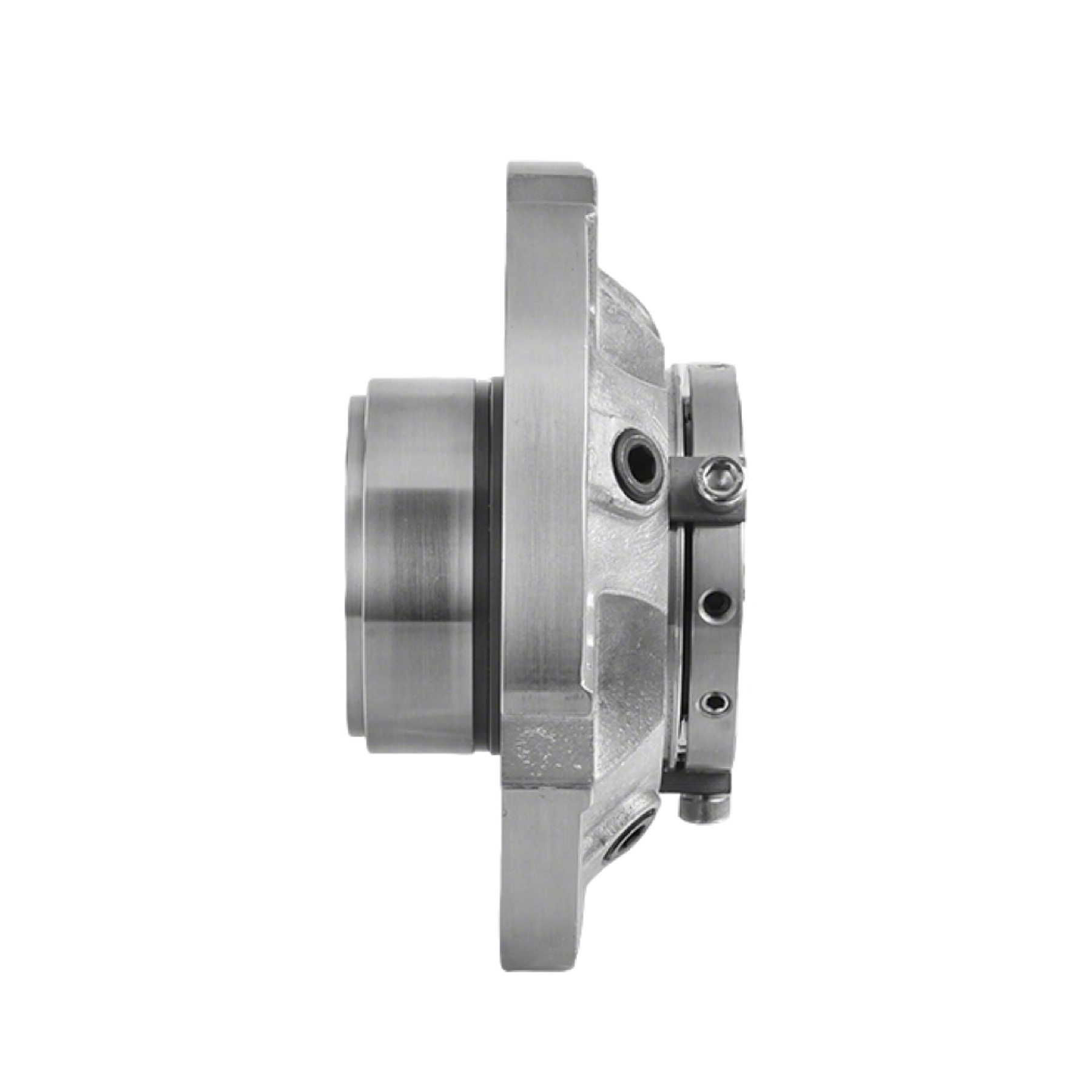
Standard mechanical seals often suffer when installers inadvertently scratch the sealing faces during manual assembly. Cartridge seals enclose these sensitive parts within a metal housing to prevent contact with environmental contaminants before installation. The cartridge configuration integrates the sleeve, gland, and seal faces into a single, pre-set assembly at the factory. Robust brass setting clips lock the internal components into their exact operational lengths before shipment. Therefore, field maintenance teams simply slide the entire cartridge onto the shaft and bolt it to the pump casing. This straightforward process removes the need for manual measurements, protecting delicate components from accidental handling damage. Additionally, manufacturers perform rigorous hydrostatic pressure testing on the complete assembly before dispatch to verify static O-ring integrity. This factory verification ensures that the hardware arrives at the job site fully operational and completely leak-free. Plant operators reduce installation time and avoid unexpected installation failures.
Integrated Multi-Port Flush Geometry: Dissipating Viscous Shear Heat to Prevent Face Flashing
Elevated systemic pressures increase fluid friction within the microscopic gap between the rotating and stationary faces. This intense friction generates substantial viscous shear heat, raising the localized temperature within the seal chamber. If the temperature exceeds the boiling point of the process fluid, the liquid film instantly vaporizes. Engineers identify this destructive phenomenon as face flashing, which leads to immediate dry running and rapid face chipping. To combat this thermal hazard, modern cartridge configurations incorporate advanced auxiliary environmental controls.
API flush plans work seamlessly with these integrated ports to optimize environmental conditions. Plant engineers can connect external piping configurations directly to the cartridge gland without modifying the auxiliary systems. Integrating multi-port flush geometry allows operators to direct cool barrier fluid directly onto the face interaction zone. This continuous flow quickly dissipates localized heat, keeping the face temperature well below the boiling point of the fluid. Furthermore, the specialized flow dynamics create a sweeping action across the seal faces, preventing particulate accumulation. High-pressure loops often carry abrasive debris that can easily score precision-lapped surfaces under strong hydraulic forces. The constant internal recirculation flushes away these harmful particulates, preserving the integrity of the sealing boundaries. Consequently, the integrated flush system maintains the necessary thermodynamic stability to ensure long-term operational reliability. This targeted cooling action protects structural components from heat-induced cracks.
Metallurgical Hardness and Precision Alignment: The GW-GU1 Technical Proof Ground
Industrial facilities demand robust equipment portfolios that align with global integrated technical standards to protect heavy-duty rotating assets. To meet this specific market requirement, GW SEAL manufactures specialized fluid isolation components. The enterprise designs the advanced GW-GU1 cartridge seal line to provide a highly reliable alternative to classic CURC structures. This engineering profile ensures direct dimensional compatibility, allowing processing plants to upgrade volatile systems without modifying existing pump casings.
The quality control division of Ningbo Guowei Mechanical Seals Technology Co., Ltd utilizes premium sintered silicon carbide and tungsten carbide faces. These ultra-hard materials resist structural deflections and maintain exceptional flatness under extreme hydraulic loads. Additionally, GW SEAL(Ningbo Guowei Mechanical Seals Technology Co., Ltd) utilizes specialized high-pressure test rigs to simulate volatile field environments before shipping. Technicians monitor flatness deviations down to fractions of a light wave using advanced optical flats. This meticulous verification minimizes initial startup friction and eliminates out-of-box anomalies. By combining superior materials with pre-set cartridge convenience, the supplier stabilizes system uptime across demanding industrial networks. This manufacturing precision guarantees reliable fluid containment.
Conclusion: Securing Processing Infrastructure via Analytical Structural Engineering
Ultimately, mitigating fluid leakage in high-pressure processing environments requires deep attention to hydraulic balancing, pre-set installation clearances, and thermodynamic boundary control. Implementing balanced cartridge configurations removes the operational vulnerabilities of manual installation errors and fluid film collapse. This engineering upgrade lowers total maintenance expenditures and extends the service life of critical rotating machinery. Choosing components backed by rigorous factory testing safeguards industrial process continuity and protects environmental integrity. Engineering departments can review complete technical datasets and dimensional profiles through GW SEAL. Explore the full range of heavy-duty balanced cartridge solutions by visiting the official website at https://www.gwseal.com/.
Hydraulic Balance Ratio Optimization: Modulating Net Face Loading Under Extreme System Pressures
Controlling the closing force between rotating and stationary seal faces remains critical when dealing with elevated system pressures. In non-balanced sealing configurations, the full hydraulic force of the process fluid pushes directly against the seal faces. Consequently, this excessive force squeezes out the crucial lubricating liquid film, causing immediate dry running and catastrophic face wear. To eliminate this issue, structural engineers adjust the internal geometry of the seal components to reduce the net hydraulic loading. This specific geometric adjustment establishes an optimal hydraulic balance ratio.
By stepping the shaft sleeve or modifying the seal face diameters, engineers effectively redistribute the hydraulic force lines within the pump housing. Therefore, only a designated percentage of the system pressure acts to close the seal faces. A precise balance ratio usually ranges between 0.60 and 0.85 for high-pressure duties. This targeted window ensures that fluid film pressure counteracts the closing forces safely without face separation. This balanced configuration maintains a stable lubricating fluid film thickness between the sliding surfaces, even during sudden pressure spikes. Furthermore, reducing the net face pressure substantially improves the pressure-velocity limits of the equipment. Consequently, the seal experiences minimal friction, lowers operational temperatures, and prevents structural cracking under heavy loads. Processing facilities achieve consistent fluid isolation without experiencing premature component degradation or face deformation. This design modification extends equipment life during volatile operations.
Pre-Assembled Monobloc Cartridge Architecture: Eliminating Manual Tolerances and Installer Error
Traditional component seals require manual assembly and precise axial adjustments during field installation inside the pump housing. However, manual installation often introduces significant compression variations due to human error or uneven gland bolt tightening. When technicians over-compress the internal springs, the seal faces experience excessive friction and fail prematurely. Conversely, under-compression causes immediate fluid leakage upon system startup because the faces lack sufficient closing force. Transitioning to a pre-assembled monobloc cartridge architecture eliminates these field installation errors entirely.
Standard mechanical seals often suffer when installers inadvertently scratch the sealing faces during manual assembly. Cartridge seals enclose these sensitive parts within a metal housing to prevent contact with environmental contaminants before installation. The cartridge configuration integrates the sleeve, gland, and seal faces into a single, pre-set assembly at the factory. Robust brass setting clips lock the internal components into their exact operational lengths before shipment. Therefore, field maintenance teams simply slide the entire cartridge onto the shaft and bolt it to the pump casing. This straightforward process removes the need for manual measurements, protecting delicate components from accidental handling damage. Additionally, manufacturers perform rigorous hydrostatic pressure testing on the complete assembly before dispatch to verify static O-ring integrity. This factory verification ensures that the hardware arrives at the job site fully operational and completely leak-free. Plant operators reduce installation time and avoid unexpected installation failures.
Integrated Multi-Port Flush Geometry: Dissipating Viscous Shear Heat to Prevent Face Flashing
Elevated systemic pressures increase fluid friction within the microscopic gap between the rotating and stationary faces. This intense friction generates substantial viscous shear heat, raising the localized temperature within the seal chamber. If the temperature exceeds the boiling point of the process fluid, the liquid film instantly vaporizes. Engineers identify this destructive phenomenon as face flashing, which leads to immediate dry running and rapid face chipping. To combat this thermal hazard, modern cartridge configurations incorporate advanced auxiliary environmental controls.
API flush plans work seamlessly with these integrated ports to optimize environmental conditions. Plant engineers can connect external piping configurations directly to the cartridge gland without modifying the auxiliary systems. Integrating multi-port flush geometry allows operators to direct cool barrier fluid directly onto the face interaction zone. This continuous flow quickly dissipates localized heat, keeping the face temperature well below the boiling point of the fluid. Furthermore, the specialized flow dynamics create a sweeping action across the seal faces, preventing particulate accumulation. High-pressure loops often carry abrasive debris that can easily score precision-lapped surfaces under strong hydraulic forces. The constant internal recirculation flushes away these harmful particulates, preserving the integrity of the sealing boundaries. Consequently, the integrated flush system maintains the necessary thermodynamic stability to ensure long-term operational reliability. This targeted cooling action protects structural components from heat-induced cracks.
Metallurgical Hardness and Precision Alignment: The GW-GU1 Technical Proof Ground
Industrial facilities demand robust equipment portfolios that align with global integrated technical standards to protect heavy-duty rotating assets. To meet this specific market requirement, GW SEAL manufactures specialized fluid isolation components. The enterprise designs the advanced GW-GU1 cartridge seal line to provide a highly reliable alternative to classic CURC structures. This engineering profile ensures direct dimensional compatibility, allowing processing plants to upgrade volatile systems without modifying existing pump casings.
The quality control division of Ningbo Guowei Mechanical Seals Technology Co., Ltd utilizes premium sintered silicon carbide and tungsten carbide faces. These ultra-hard materials resist structural deflections and maintain exceptional flatness under extreme hydraulic loads. Additionally, GW SEAL(Ningbo Guowei Mechanical Seals Technology Co., Ltd) utilizes specialized high-pressure test rigs to simulate volatile field environments before shipping. Technicians monitor flatness deviations down to fractions of a light wave using advanced optical flats. This meticulous verification minimizes initial startup friction and eliminates out-of-box anomalies. By combining superior materials with pre-set cartridge convenience, the supplier stabilizes system uptime across demanding industrial networks. This manufacturing precision guarantees reliable fluid containment.
Conclusion: Securing Processing Infrastructure via Analytical Structural Engineering
Ultimately, mitigating fluid leakage in high-pressure processing environments requires deep attention to hydraulic balancing, pre-set installation clearances, and thermodynamic boundary control. Implementing balanced cartridge configurations removes the operational vulnerabilities of manual installation errors and fluid film collapse. This engineering upgrade lowers total maintenance expenditures and extends the service life of critical rotating machinery. Choosing components backed by rigorous factory testing safeguards industrial process continuity and protects environmental integrity. Engineering departments can review complete technical datasets and dimensional profiles through GW SEAL. Explore the full range of heavy-duty balanced cartridge solutions by visiting the official website at https://www.gwseal.com/.
Ningbo Guowei Mechanical Seals Technology Co., Ltd
+ +86 574-88241891
email us here
Visit us on social media:
LinkedIn
Facebook
YouTube
Legal Disclaimer:
EIN Presswire provides this news content "as is" without warranty of any kind. We do not accept any responsibility or liability for the accuracy, content, images, videos, licenses, completeness, legality, or reliability of the information contained in this article. If you have any complaints or copyright issues related to this article, kindly contact the author above.


