


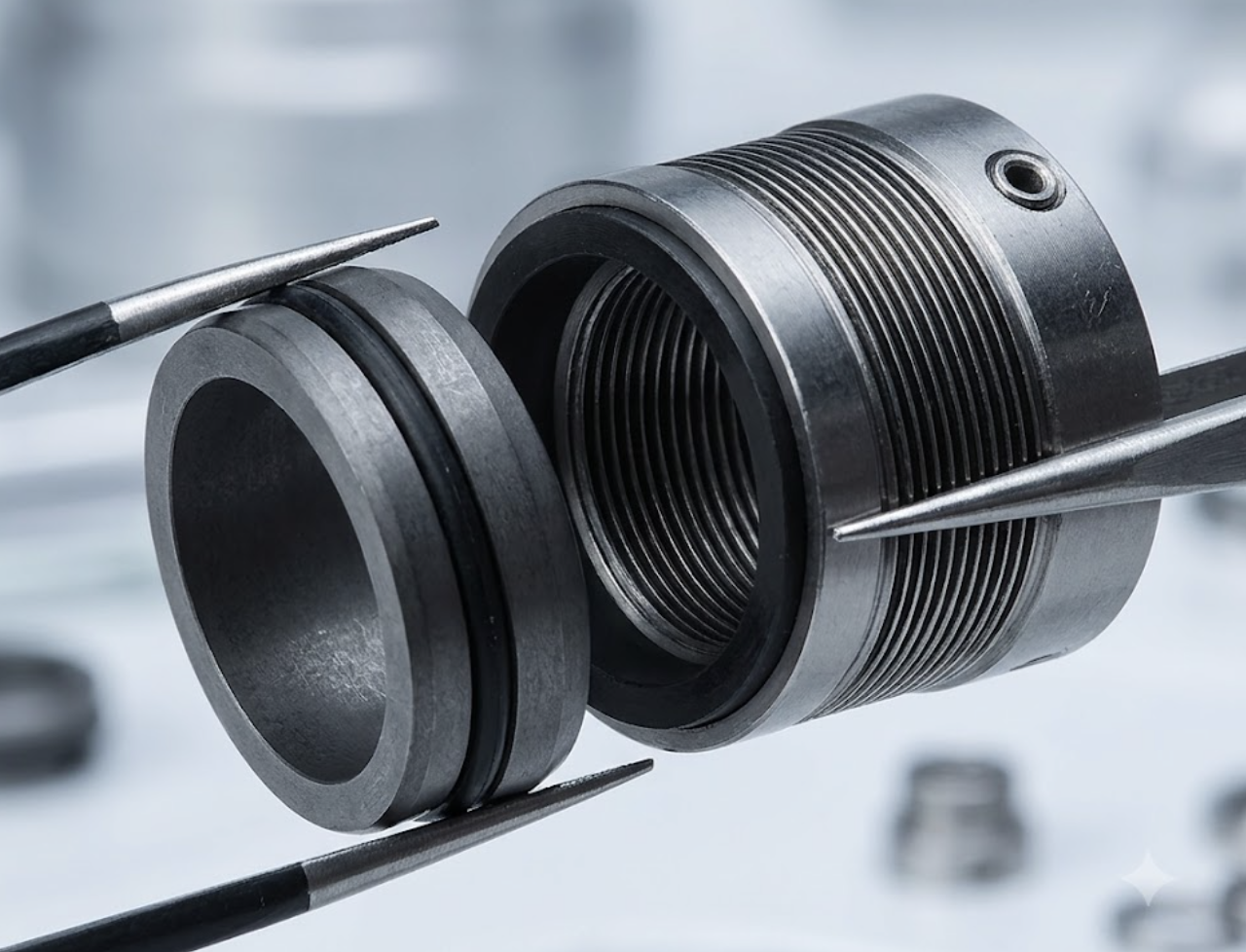

Eliminating Hysteresis and Shaft Fretting: The Tribological Shift in Cryogenic Sealing
Implementing edge-welded metal bellows systems marks a major advancement in industrial fluid isolation technology. Traditional mechanical designs utilize dynamic secondary elastomers to accommodate axial shaft movement during operation. However, these moving O-rings frequently get stuck on the shaft sleeve due to particulate accumulation. Engineers define this restrictive operational phenomenon as mechanical hysteresis. Hysteresis prevents the primary sealing faces from maintaining optimal contact, causing immediate fluid leakage. Furthermore, the constant rubbing action of dynamic elastomers damages underlying metal components. This persistent abrasive movement causes localized grooving, which engineers recognize as severe shaft fretting.
Transitioning to a welded bellows architecture resolves these mechanical issues completely. The welded metal core acts as a static sealing element, removing the need for dynamic O-rings. Because no components slide along the shaft, the pump sleeve remains entirely free from abrasive wear. Additionally, the inherent spring rate of the bellows core delivers constant closing force. This elastic configuration maintains uniform parallel face contact during rapid thermal expansion or contraction cycles. Consequently, processing facilities achieve superior leakage control without sacrificing component longevity.
Micro-Metallurgical Auditing: ISO9001 Requirements for Edge-Welded Bellows Plate Consistency
Manufacturing high-performance metal bellows demands exceptional control over thin-gauge metallurgy. Standard quality frameworks mandate comprehensive micro-metallurgical audits to verify weld integrity across all production batches. Inspectors evaluate individual bellows plates under advanced optical magnification to detect structural variations. Specialized technicians utilize automated micro-plasma or laser edge-welding systems to fuse the thin steel foils. The ISO9001 protocol requires complete consistency in the welding bead topology to prevent localized stress areas.
Furthermore, production engineers must monitor the heat-affected zone around each weld joint. Excessive thermal exposure during welding can alter the crystalline structure of the metal foil, creating brittle sections. Therefore, operators calibrate welding parameters continuously to preserve material ductility. Technicians also audit incoming plate thickness to ensure absolute geometric uniformity across the bellows stack. Eliminating minor dimensional variations prevents localized structural deformation during high-pressure compression cycles. These stringent metallurgical controls insulate the finished hardware from premature cracking under severe operational stress.
Quantifying Structural Endurance: Hermeticity and Accelerated Fatigue Testing Protocols
Verifying long-term sealing reliability requires strict compliance with advanced physical testing standards. Top-tier manufacturing facilities utilize high-vacuum helium mass spectrometer leak detection systems to audit every bellows assembly. Technicians subject the components to absolute vacuum conditions to evaluate joint hermeticity. The ISO9001 certification framework restricts maximum allowable leakage rates to below 1x10⁻⁸ mbar l/s. Any assembly exceeding this strict limit fails the quality benchmark immediately.
In addition to leak detection, factories conduct accelerated lifecycle fatigue testing on sample batches. Specialized testing rigs compress and expand the bellows core through hundreds of thousands of mechanical cycles. This destructive evaluation simulates years of rigorous field service under volatile pressure profiles. Engineers also execute hydrostatic burst pressure tests to determine ultimate mechanical safety margins. These quantitative evaluations confirm that the bellows core can withstand sudden system pressure spikes. Maintaining comprehensive testing logs ensures that international buyers receive completely reliable hardware for volatile fluid networks. Procurement teams utilize these verified performance datasets to evaluate factory capabilities objectively.
Material Matrix Auditing: High-Performance Alloys for Volatile Processing Loops
Selecting appropriate metallurgy determines the ultimate environmental resilience of a metal bellows seal. Industrial processing plants frequently handle highly corrosive media, volatile acids, and aggressive chemical solutions. Therefore, quality assurance teams audit raw material intake protocols carefully to verify chemical compositions. Top-tier factories utilize premium alloys, including AM350, Hastelloy C-276, and Inconel 718, to manufacture the bellows stacks. These advanced metals retain excellent tensile strength and elasticity across a wide temperature spectrum.
Auditors verify compliance with international material standards to prevent stress corrosion cracking in aggressive fluids. Premium alloy coils undergo specialized heat treatment processes to optimize their grain structures. This precise metallurgical conditioning guarantees excellent sub-zero ductility, even at temperatures descending past minus 40 degrees Celsius. Consequently, the finished bellows core resists premature embrittlement during cryogenic processing runs. Ensuring raw material traceability through official mill certificates remains a foundational requirement of quality certifications systems. This rigorous oversight prevents sub-standard metals from entering the production line, safeguarding global infrastructure assets.
Supply Chain Isolation Benchmarks: The GW SEAL Zero-Defect Welded Portfolio
Global industrial enterprises require transparent manufacturing partners to protect their rotating machinery investments. The manufacturing facility GW SEAL (Ningbo Guowei Mechanical Seals Technology Co., Ltd) satisfies this critical market demand. The enterprise operates a modern production facility governed by a strict, certified quality management system. Specifically, the engineering team develops the welded metal bellows seal for low temperature john crane type 680 alternative line to deliver direct drop-in interchangeability. This precise dimensional matching allows refinery operators to upgrade volatile pump systems without altering existing housings.
The quality assurance division of GW SEAL binds raw material heat numbers, welding data, and vacuum test results into a unified trace record. This comprehensive data management allows procurement managers to verify component compliance easily before installation. Furthermore, the specialized manufacturing center of Ningbo Guowei Mechanical Seals Technology Co., Ltd integrates advanced diamond-lapping processes to optimize face flatness. Restricting face deviations to fractions of a light wave minimizes initial startup friction. By eliminating out-of-box anomalies, the provider stabilizes equipment uptime across extensive municipal and industrial pumping networks.
Conclusion: Insulating Procurement Infrastructure through Standardized Quality Vectors
In conclusion, standardizing vendor qualification around rigorous ISO9001 parameters protects critical process loops from catastrophic sealing failures. Evaluating micro-metallurgical consistency, vacuum hermeticity, and accelerated fatigue performance helps procurement managers identify top-tier manufacturing partners. Transitioning to edge-welded metal bellows configurations eliminates the mechanical risks of dynamic elastomer degradation and shaft fretting. This strategic upgrade significantly lowers total maintenance expenditures across rotating equipment networks. Ultimately, choosing certified manufacturing quality safeguards industrial process continuity and extends equipment service life. Engineering teams can access full dimensional drawings and comprehensive material specification logs through GW SEAL. Explore the complete portfolio of advanced fluid isolation solutions by visiting the official corporate website at https://www.gwseal.com/.
Ningbo Guowei Mechanical Seals Technology Co., Ltd
Ningbo Guowei Mechanical Seals Technology Co., Ltd
+86 574 8824 1891
email us here
Visit us on social media:
LinkedIn
Facebook
YouTube
Legal Disclaimer:
EIN Presswire provides this news content "as is" without warranty of any kind. We do not accept any responsibility or liability for the accuracy, content, images, videos, licenses, completeness, legality, or reliability of the information contained in this article. If you have any complaints or copyright issues related to this article, kindly contact the author above.
