


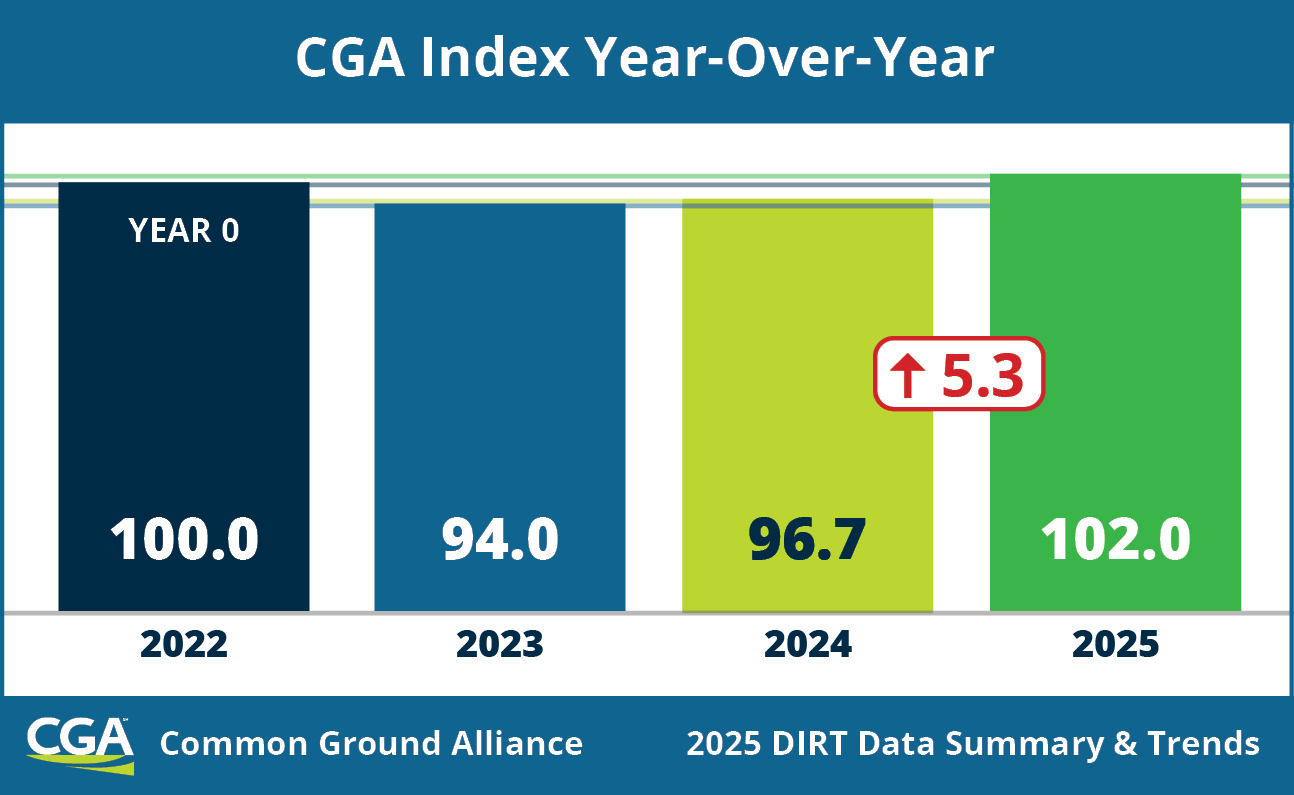
The CGA Index measures year-over-year changes in buried utilities damage trends, measured from a 2022 baseline.
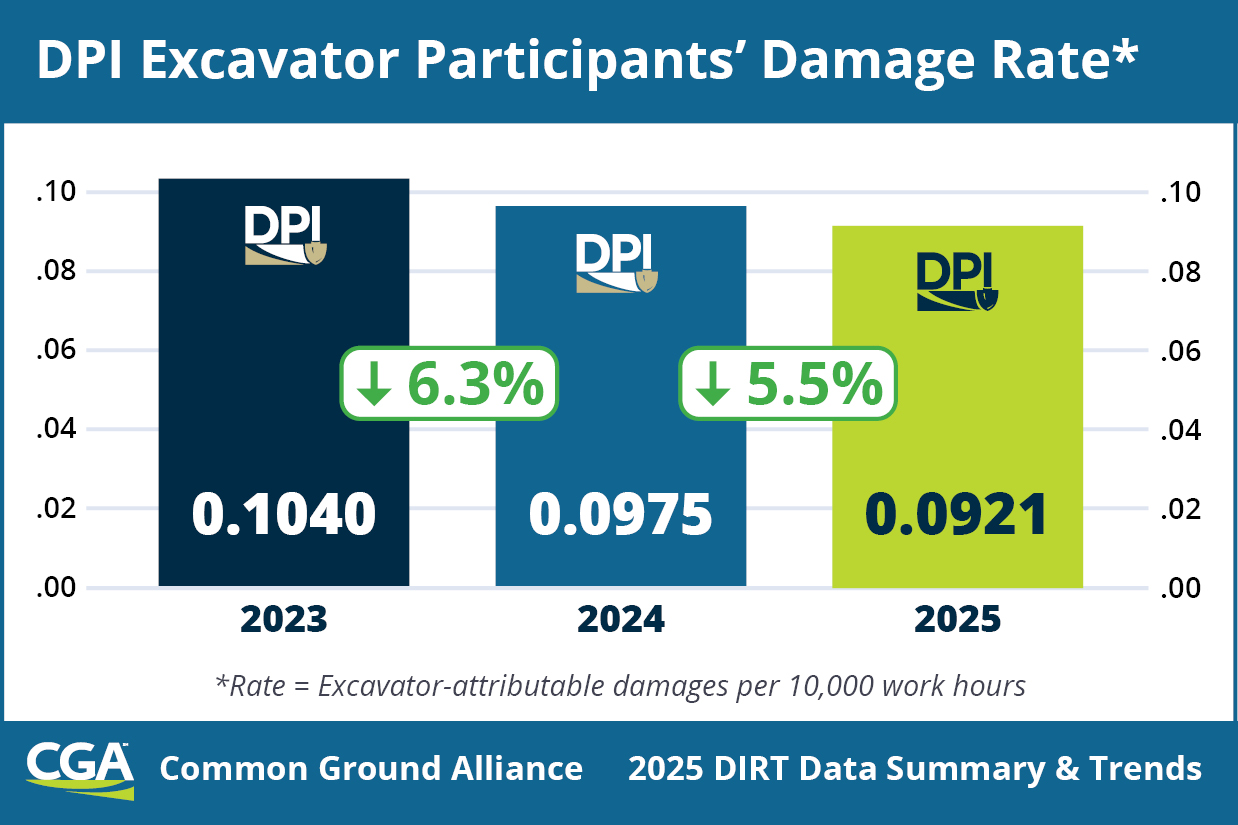
2025 DIRT data includes a measurement of excavator-attributable damages per 10,000 work hours, which has declined in the past three years.
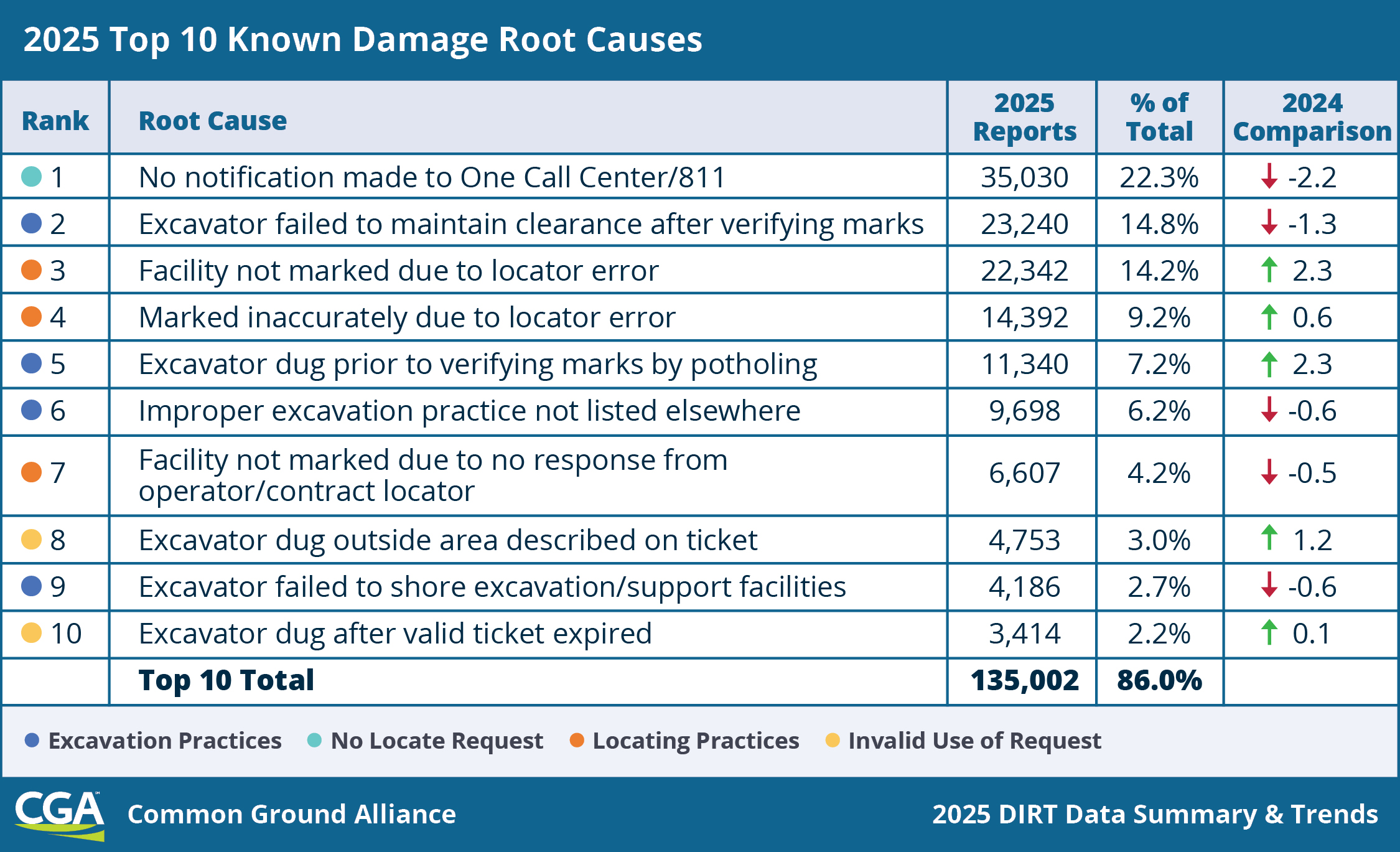
2025 DIRT data includes a listing of the top ten root causes of damage to buried utilities, which is led by not contacting 811 prior to digging. Image courtesy of CGA © 2026.
According to the CGA Index, damages in 2025 were up more than 5 points from the year prior
DIRT Data Summary & Trends: CGA has published a summary of key findings from 2025 DIRT data in addition to the new Damage Prevention Dashboard. CGA’s DIRT Summary & Trends analyzes 221,717 unique damage reports from 2025, demonstrating that damages continue to rise alongside construction activity (as measured by GDP). CGA will release a full State of Damage Prevention Report this fall, contextualizing 2025 DIRT data with broader industry and economic trends, and recommendations for the sector.
CGA Index: Developed in 2023, the CGA Index is a statistically modeled national measure of damage to buried utilities year-over-year. The CGA Index showed modest improvement from 2022 to 2023 before trending upward in 2024 and 2025. The 2025 CGA Index score of 102 exceeds the original baseline score and indicates an 8-point increase in damages since 2023.
“The 2025 DIRT Data Summary & Trends underscores a serious call to action we cannot afford to ignore," said CGA President and CEO Sarah K. Magruder Lyle. "As damages to buried infrastructure continue to grow alongside construction activity, inadequate damage prevention policies are failing our communities and businesses. To protect public safety and secure the critical utilities on which all Americans rely, the entire industry must commit to tangible, enforceable accountability across all stakeholders. This includes mandating modern mapping practices, implementing effective laws and investing in technologies that will create a more efficient, reliable damage prevention system."
Reductions Achieved by DPI Excavators: While the DIRT data shows damages rising nationally from 2023-2025, excavator participants in CGA’s Damage Prevention Institute (DPI) moved in the opposite direction. DPI excavators reduced their rate of attributable damages per 10,000 work hours by more than 11% over the same time period. DPI excavator participants commit to following CGA’s Best Practices, submitting damage data and other key metrics on a monthly basis, and participating in peer reviews of their damage prevention programs.
Top Facilities Damaged and Work Performed
Telecom/cable TV (CATV) and natural gas facilities continue to bear the greatest damage burden, together accounting for 87% of all facility damage reports submitted in 2025 – 51% and 36%, respectively – followed by electric (8%) and water/sewer (5%).
Breaking this down further by facility type reveals distinct patterns. For telecom/CATV, damage is most often self-inflicted: Telecom/CATV work itself accounts for 30% of the damage to those facilities, followed by water/sewer work (22%). For natural gas, the top offender is external: Water/sewer work is responsible for 27% of natural gas facility damage, followed by telecom/CATV work (20%) and construction/development (17%).
Persistent Root Causes
CGA’s 2025 DIRT Data Summary & Trends analysis shows that systemic challenges remain highly consistent year-over-year, with little movement in the top 10 root causes which account for 86% of all reported damages. Failure to notify before digging remains the single largest root cause of damages every year.
New Comprehensive Damage Prevention Dashboard
Alongside the 2025 DIRT Data Summary & Trends, CGA launched an updated interactive Damage Prevention Dashboard that combines information sourced from One Call/811 Centers with DIRT data from 2023-2025. The new Damage Prevention Dashboard enables stakeholders to explore not only damage trends by region – but also to view locate request volume, law information and center requirements by state.
"CGA’s Data Reporting and Evaluation Committee worked to get the 2025 DIRT data into stakeholders' hands in a more usable format than ever before," said Louis Panzer, Executive Director of North Carolina 811 and Co-Chair of CGA's Data Reporting and Evaluation Committee. "This data makes clear where the industry needs to focus its efforts. By combining the rich data from One Call/811 centers with DIRT data, the Damage Prevention Dashboard gives stakeholders, states and individual organizations a clearer path to identifying the opportunities for actions that will result in measurable improvement."
The complete 2025 DIRT Data Summary & Trends, including a slide deck, downloadable charts and graphs, and the newly updated Damage Prevention Dashboard are available to the public at dirt.commongroundalliance.com.
About CGA: Common Ground Alliance (CGA) is a member-driven association of nearly 4,000 damage prevention professionals spanning every facet of the underground utility industry. Established in 2000, CGA is committed to saving lives and preventing damage to North American underground infrastructure by promoting effective damage prevention practices. CGA is the preeminent source of damage prevention data and information in an effort to reduce damages to underground facilities through shared responsibility among all stakeholders.
Franco Ripple
Common Ground Alliance
+ +1 352-219-6029
email us here
Legal Disclaimer:
EIN Presswire provides this news content "as is" without warranty of any kind. We do not accept any responsibility or liability for the accuracy, content, images, videos, licenses, completeness, legality, or reliability of the information contained in this article. If you have any complaints or copyright issues related to this article, kindly contact the author above.
