


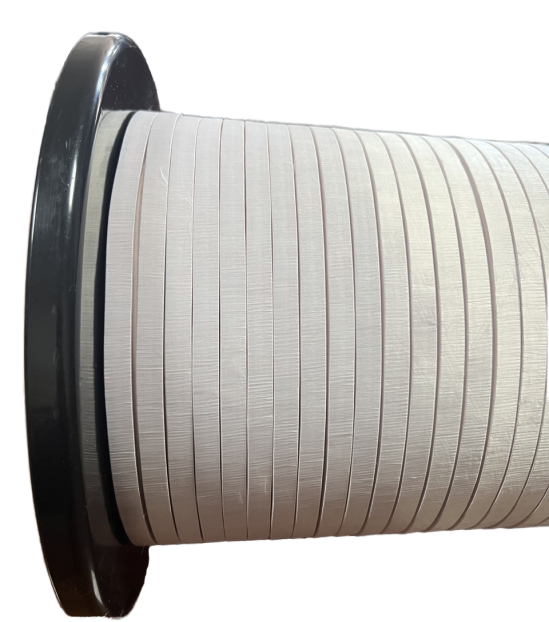
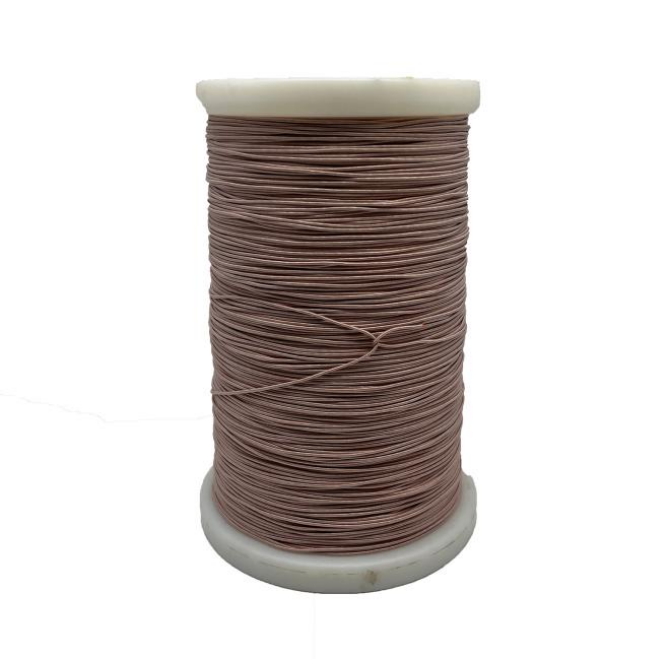
The short answer to why engineers choose this kind of wire: skin effect and proximity effect waste energy at high frequencies. Splitting the conductor into many thin, individually insulated strands solves that. Wrapping those strands in silk or nylon then handles the mechanical and dielectric side of the problem.
Why Do High-Frequency Windings Need Served Litz Wire?
Served litz wire exists because standard magnet wire loses efficiency once frequencies climb. As current speeds up, it crowds toward the outer surface of a conductor and pushes away from neighboring wires. That behavior raises resistance and heat exactly where you don't want it.
Litz construction fights this by using many fine strands, each carrying a share of the current. A textile serving layer—natural silk or nylon yarn—then wraps the twisted bundle. This outer jacket does three jobs at once: it holds the strands in place, adds mechanical protection, and keeps the dielectric loss low.
In sensitive gear like high-end acoustic systems, mechanical resonance matters as much as electrical loss. A silk-served bundle dampens microphonic vibration that would otherwise leak into the signal path. That's the practical reason so many audio and medical designs specify served litz over bare enameled bundles.
Single Served vs Double Served: Which One Fits Your Application?
Pick single served for lighter, more compact coils; pick double served when abrasion resistance and insulation margin matter more. The choice changes the coil's flexibility, mass, and mechanical damping directly.
Here's how the two structures compare in real use:
Single served (one textile layer): lower mass, thinner profile, tighter winding radius. Good for compact sensor coils and space-limited audio windings where every millimeter counts.
Double served (two textile layers): stronger abrasion resistance, extra dielectric buffer, better structural integrity. Preferred for wireless charging transmitters and high-frequency inductors that face thermal cycling.
A useful way to think about it: single served tunes for suppleness and space, double served tunes for durability and voltage safety. In a wireless charging transmitter coil, for example, the second silk layer acts as a mechanical cushion, absorbing the expansion stress from rapid heating and cooling. That helps the coil hold a steady inductance value over long service.
The layer count also shifts acoustic behavior. Engineers building Hi-End audio cables often tune the served thickness to neutralize specific microphonic frequencies, treating the silk almost like a filter for unwanted vibration.
How Does RVYUAN Keep Ultra-Fine Strands Structurally Stable?
Structural stability comes from active twist control, not luck. Bundling hundreds of enameled strands thinner than 0.025mm creates real torsional stress, and if that stress isn't neutralized, the bundle loosens and loses its round shape.
The production line handles this through a grouped back-twisting method. The process works in stages:
Grouped back-twisting and lay optimization. Alternating clockwise and counter-clockwise twist directions across layers cancels out the internal rotational forces. A gradually adapted twisting pitch then settles the bundle into a uniform, round cross-section, so the wire feels equally supple along its full length.
Closed-loop serving tension control. The wrapping equipment monitors tension online and adjusts the flyer arm's centrifugal force and payoff angle in real time. Too much tension stretches the copper or scrapes the thin polyurethane film; too little lets strands scatter during cutting or winding. The feedback loop keeps it in the safe middle.
Cleanroom alignment and guide die processing. Serving happens inside cleanroom areas, where multi-channel eyelet guide plates hold every strand in position. This alignment lets the natural silk reach coverage density above 99 percent, giving a smooth jacket that resists shifting during sharp bends.
Each stage targets one problem. Together they explain how a fine-strand single or double served litz wire keeps its geometry through high-tension automatic winding.
Why Does Natural Silk Insulation Improve Signal Quality?
Natural silk lowers capacitive coupling because it has a very low dielectric constant compared to synthetic polymers. Less coupling between parallel conductors means cleaner high-frequency signal transmission with less phase distortion.
This matters most in two settings. In audiophile cables, silk works as a physical buffer that dissipates microphonic noise created by the electromagnetic fields inside the jacket. The sound stays closer to the original signal because mechanical noise doesn't ride along with it.
In high-power electronics, the same silk serving earns its place differently. A double served jacket adds insulation security against voltage breakdown and cushions the coil against thermal expansion. Power coils built this way tend to run cooler and hold their inductance steadier over time—useful for wireless charging and high-frequency inductor work.
How Does Conductor Metal Change the Manufacturing Process?
Different core metals need different processing settings, so RVYUAN adjusts parameters per material rather than running one fixed recipe. The company handles solid silver, silver-plated copper, and high-purity OCC (Ohno Continuous Casting) copper, each with its own mechanical and thermal behavior.
A few concrete adjustments show why this matters:
OCC copper is highly ductile, so it runs at lower serving tension to avoid stretching the wire.
Silver alloys are stiffer, so annealing temperature profiles get recalibrated to keep flexibility uniform.
Silver-plated copper sits between the two and needs its own balance of heat and tension.
The engineering team resets annealing profiles and textile pre-tension for every run. The goal is consistency: no matter which core metal a customer picks, the silk adhesion stays uniform and the finished wire behaves the same way on automated winding floors. That predictability is what buyers actually rely on.
Talk to a Global Leading Single or Double Served Litz Wire Supplier
If you're designing a coil that needs a specific served thickness, conductor metal, or coverage density, sharing your operating frequency and winding constraints early saves iteration time. RVYUAN builds to measurable targets—insulation concentricity, thermal breakdown resistance, and high-frequency quality factor—rather than fixed commodity formats.
The team supports OCC copper, silver-plated copper, and solid silver cores in both single and double served configurations, backed by testing that checks compliance with international safety and quality protocols. For technical specifications, sample requests, or a custom design consultation, please visit the corporate portal at https://www.rvyuan.com/
Tianjin Ruiyuan Electric Material Co.Ltd
Tianjin Ruiyuan Electric Material Co.Ltd
+86 22 88333337
email us here
Legal Disclaimer:
EIN Presswire provides this news content "as is" without warranty of any kind. We do not accept any responsibility or liability for the accuracy, content, images, videos, licenses, completeness, legality, or reliability of the information contained in this article. If you have any complaints or copyright issues related to this article, kindly contact the author above.
